French Listening Comprehension

Become confident when speaking and listening French

Are you looking to get some French listening comprehension practice? Don’t look any further… ACCORD’s intensive French lessons are what you are looking for and so much!

More than 1.700 students come from all over the world to ACCORD language school in Paris each year to improve their French language skills, including their French listening comprehension. ACCORD’s French immersion courses in France for adults combine an authentic French environment with high-quality French lessons, focusing to help students improve their French in all areas, speaking, listening, reading and writing.

In as little as one or two weeks in the ‘intensive French course ‘C’ (26 hours/week, which means 34 language lessons of 45 minutes per week!) at the ACCORD French Language School located nearby the Eiffel Tower, in the lively 15th arrondissement, students can practise and make impressive progress in fields such as French listening comprehension and French oral communication, feeling confident to use their French skills outside the classroom environment.

With lessons in multinational classes every morning Monday to Friday and two afternoon lessons on Monday and Friday dedicated to French oral communication, ACCORD French course ‘C’ provides students with many opportunities for French listening comprehension practice. As students are placed in classes of their level of French, learners are sure that they are getting the most effective learning experience for their linguistic level.
In multinational groups, students can practise their oral communication with their fellow students who are at the same level as them and continue speaking French during break times and after lessons are finished. ACCORD courses also prepare students for their A/AS level, ILC and Abitur French exams as often these students need to focus on improving their confidence when speaking and listening to pass their French exam easily and get the marks they want.

ACCORD qualified and experienced teachers, through French listening comprehension tests, make sure that all students improve their linguistic skills effectively, whether they are complete beginners learning the language for the first time, or advanced students looking to continue improving for professional reasons or simply because they want to be able to watch a French film without the subtitles, sing one of the famous French songs such as l’Hymne à l’Amour or read one of our France’s literary masterpieces in French such as Le Petit Prince or Les Misérables.

For those who prepare a French language diploma such as the TCF, DELF and DALF, French listening comprehension practice is essential, because these exams include oral tests.

For those wishing to hone their linguistic skills in a niche area, such as French for business or law, for example, the ACCORD French Language School in Paris also offers tailor-made courses which are highly beneficial for these students.

If you’re looking for the most valuable French listening comprehension courses, ACCORD’s experience and versatility make them the language school of your choice.

So, what are you waiting for…

Contact us


What to do in Paris in September?

Vive la rentrée !

The summer holidays are a serious business in France, with French schools closed for 8 weeks and French families taking an average of 3 weeks off over the summer. That makes September the time for everyone to resume their day-to-day routine, whether that be going back to school or back to work. La rentrée also captures the renewed and fresh energy that comes after a well-deserved break. Whilst you’re at our ACCORD French Language School in September, you’ll notice a whole host of new programmes on the TV, new stock in the shops and window displays, new exhibitions at museums and cultural venues as well as new reforms from the politicians. Now it’s time for you to embrace la rentrée and experience something new…

Events

Exhibitions (new for September)

Concerts and Live Music

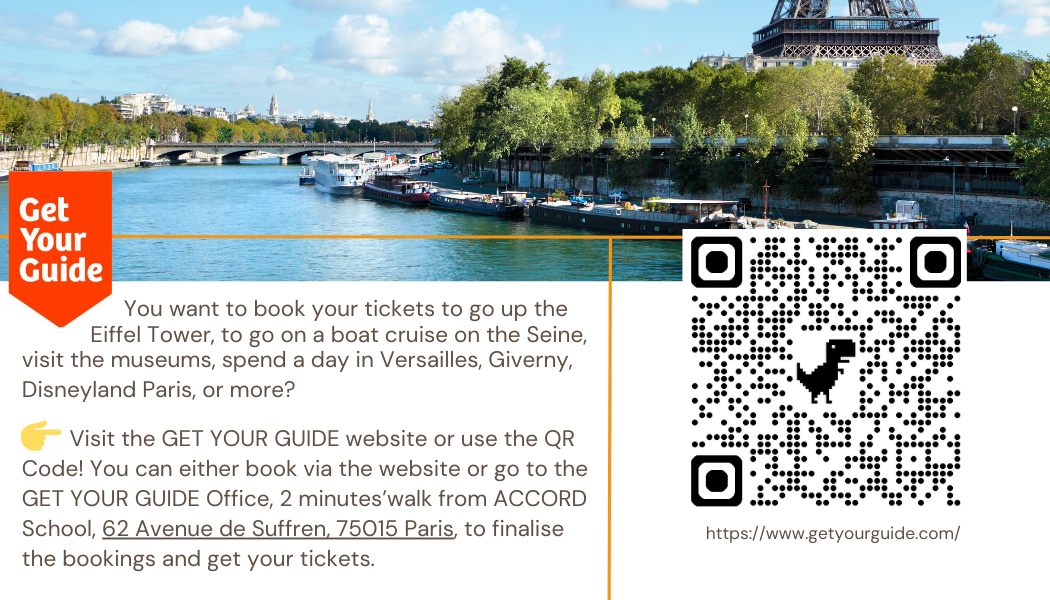
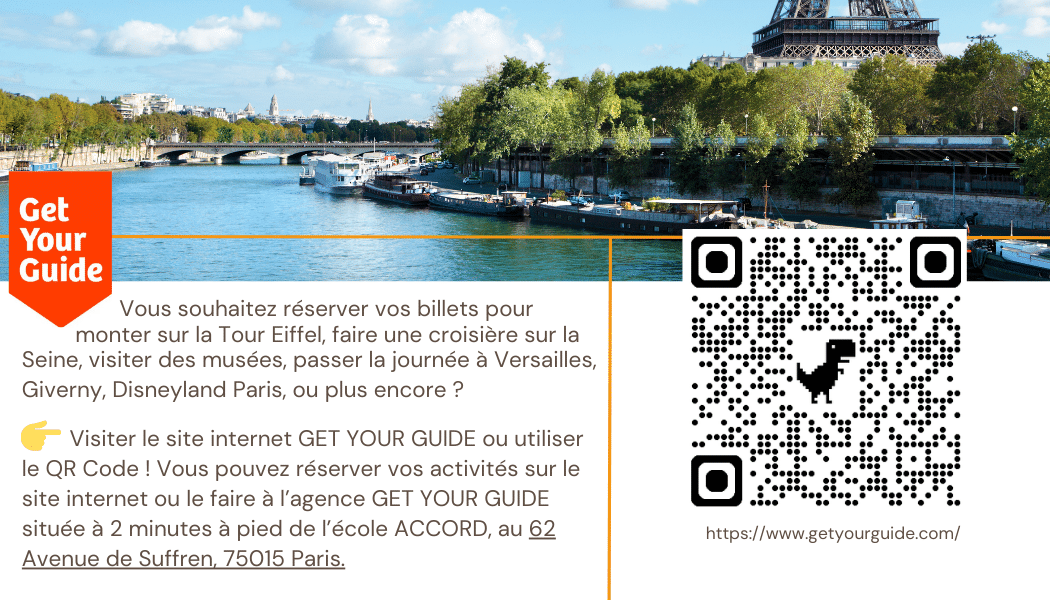
Extra Tip: The partnership established by the ACCORD French language school with the GET YOUR GUIDE agency allows all students of the ACCORD school to participate in the visits and cultural program offered by this agency whose office is located two minutes from the school, 62 avenue de Suffren, in Paris.

Students can, in addition to their French language course, sign up for visits to famous museums or monuments, a cruise on the Seine or the Canal Saint-Martin, an excursion to Giverny, Versailles, Honfleur, or even to Mont Saint-Michel or Disneyland Paris.

Contact ACCORD Paris


The Gardens of Paris: A Selection by ACCORD Paris Students

The Gardens of Paris: A Selection by ACCORD Paris Students

All it takes is a ray of sunshine and a blue sky for Paris to reveal its best side. Between two French classes, it’s hard to resist the pull of shaded lawns, ponds where little wooden sailboats drift by, and tree-lined paths flanked by century-old statues. The French capital is full of parks, gardens, and squares, each with its own history and atmosphere. Here’s a selection of the Parisian gardens most loved by students at ACCORD French language school, spanning royal heritage, scientific botany, and everyday Parisian relaxation. (In an upcoming post, we’ll share our students’ favorite parks too, stay tuned!)

Tuileries Garden

Let’s start with the Tuileries Garden, whose name comes quite simply from the tile factories (“tuileries”) that once stood on this land, before Queen Catherine de’ Medici had a palace built here in 1564, long since gone, but whose name stuck to the garden that replaced it. It was the famous landscape architect André Le Nôtre who, from 1664 onward, gave the garden the look we know today: the geometric, symmetrical style known as the “jardin à la française,” or French formal garden (**). Stretching between the Louvre and Place de la Concorde, the Tuileries is one of the most beloved places to stroll in Paris, for locals and ACCORD students alike, who love wandering among sculptures by Maillol, Rodin, and Giacometti.

(**) The “jardin à la française,” perfected by André Le Nôtre, is defined by its geometric layout and perfect symmetry. The Tuileries and the Luxembourg Gardens are both classic examples. The “jardin à l’anglaise,” or English garden, by contrast, embraces a wilder, more natural look with irregular shapes, as seen at Parc Monceau and Parc Montsouris.

Palais Royal Garden

Just steps from the Louvre, the Palais Royal Garden was created in 1633 by Cardinal Richelieu. It served as home to the royal family for years before they relocated to Versailles. Today, this elegant, peaceful garden is framed by remarkable architecture that stays firmly rooted in the present, with striking contemporary artwork throughout. Its best-known feature is the Buren Columns, a work by artist Daniel Buren installed in the courtyard next to the garden, near the Ministry of Culture: black-and-white striped octagonal columns that have become one of the most photographed symbols of Paris.

Jardin des Plantes

In the heart of Paris, the Jardin des Plantes offers a genuine slice of nature. This botanical garden, founded four centuries ago, still serves its original dual purpose: advancing scientific research and welcoming the public. Between its remarkable trees, statues, and pathways, it offers visitors a varied and beautifully preserved place to wander, complete with a few hidden, quiet corners. Across its 2.5 hectares of “jardin à la française,” you can lose yourself among plants from every corner of the world, get a first taste of botany, or admire trees loaded with history, including a pistachio tree that’s 315 years old, the garden’s silent elder.

Luxembourg Gardens

On the edge of Saint-Germain-des-Prés and the Latin Quarter, the Luxembourg Gardens were inspired by Florence’s Boboli Gardens and created in 1612 at the request of Queen Marie de’ Medici. Across its 25 hectares, the garden combines a French formal section and an English-style section, divided by a geometric forest and a large central pond. There’s also an orchard of rare, heirloom apple varieties, a small apiary for learning about beekeeping, greenhouses housing a breathtaking orchid collection, and a rose garden. The park counts no fewer than 106 statues, the monumental Medici Fountain, an Orangerie, and the Davioud Pavilion. It’s also a lively meeting place where Parisians and ACCORD students alike play chess, tennis, or bridge, or watch wooden sailboats glide across the pond. Culturally, the garden regularly hosts free open-air photography exhibitions along its railings, plus concerts at the bandstand.

Champs-Élysées Gardens

The Champs-Élysées Gardens stretch from Place de la Concorde to the Rond-Point des Champs-Élysées, flanking Paris’s most famous avenue on both sides. While their current layout dates back to 1840, their origins go back to the 17th century. In their most wooded section, they hold plenty of surprises: statues, fountains, and a bandstand, must-see museums (the Grand Palais, Petit Palais, and Palais de la Découverte), performance venues (Théâtre Marigny, Théâtre du Rond-Point, Théâtre de Guignol), and celebrated restaurants (Pavillon Ledoyen, Restaurant Laurent). Between majestic trees and colorful flowerbeds, it’s an essential stop for Parisians and ACCORD students alike.

A Student’s Tip

Barbara, a German student at ACCORD, shares her favorite spot: “Above all, don’t forget to visit the oldest tree in Paris — a black locust planted in 1601. For more than four centuries, it has stood proudly in Square René-Viviani, right in the heart of the Latin Quarter, and it truly is a striking sight to see.”

Your Turn to Explore

These gardens are just a glimpse of Paris’s green riches, each with its own atmosphere, its own history, and its own quiet invitation to slow down for a while. The best way to discover them? Lace up comfortable shoes, step out of the classroom between two French lessons, and let the paths guide you. And since learning French in Paris doesn’t stop at the classroom door, every one of these gardens doubles as the perfect place to practice: ask for directions, strike up a conversation with a Parisian feeding the pigeons, or simply listen to the French being spoken around you as you read a few pages in the shade of a tree.

So, which garden will be first on your list?

Contact us


Student Visa for France: Everything You Need to Know

Student Visa: What You Need to Know Before Studying at ACCORD Paris

So, you’ve decided to learn French in Paris. Congratulations, you’re about to start an unforgettable adventure! But before you picture yourself ordering une baguette bien cuite at your neighbourhood bakery or chatting with locals on a café terrace, there’s an important administrative step to sort out first: the visa.

Visa rules can feel confusing, especially when they depend on your nationality, the length of your stay, and the type of course you’re booking. To help you prepare with confidence, we’ve put together this practical guide answering the questions we hear most often from our future students. Here’s everything you need to know before packing your bags for Paris.

I Would Like to Follow a French Course at ACCORD. Do I Need a Visa to Book a Course?
No, you do not need a visa to study at ACCORD French Language School in Paris.
However, you may need a visa to enter France.

Do I Need a Visa to Come to France?
If you are a citizen of the European Union, a member state of the European Economic Area or Switzerland, you do not need a visa to come to France.
For students of other nationalities, depending on your nationality and the length of your stay, you may need a visa. There are several types of visas:

  • Short-stay visa:
    “Uniform Schengen” short-stay visa
    Short-stay visas for non-European French territories
    All information about these visas is on https://france-visas.gouv.fr/en/visa-de-court-sejour
  • Long-stay visa:
    For any stay in France exceeding 90 days, you are required to apply in advance for a long-stay visa. In this instance your nationality does not exempt you from requirements. There are two main types of long-stay visas.
    All information about long-stay visas are on https://france-visas.gouv.fr/en/visa-de-long-sejour

Can ACCORD French Language School Provide Me With a Visa?
No, ACCORD does not provide visas, as French language schools are not recognised and allowed to deliver a visa. If you have any questions about visas, please contact the French Embassy and/or the Campus France office nearest to you.
Important information: Due to the increase in the required income threshold for long-stay student visas, applications submitted starting August 1, 2026, will need to be accompanied by proof of income corresponding to a minimum of €877.50 per month.
More information on the official website of the French Ministry of Foreign Affairs: https://france-visas.gouv.fr/en/accueil

Is There an Official Website or a Webpage Where I Can Check My Visa Need?
Yes, here: https://france-visas.gouv.fr/en/assistant-visa

Is an Online Visa Application Possible?
Yes, here: https://france-visas.gouv.fr/en/demande-de-visa

Can ACCORD Language School Help Me Get a Visa?
Once we have received your complete registration (registration form and full payment by bank transfer for the programme or the requested and non-refundable deposit), we will send you an official letter of invitation also called letter of acceptance to be submitted with your application to the Embassy.
It is your responsibility to gather the other documents required by the embassy for your visa application (proof of income, passport, photos, payment of administrative fees, etc) and make sure you meet all eligibility criteria.

Are There Any Fees for Studying at the ACCORD French Language School in Paris?
Yes, and you can access our 2026 and 2027 tuition fees on our official website: https://www.accord-langues.com/accord-dates-and-prices/

How Do I Register for a French Language Program at ACCORD?
To book your French language course, you must complete an online registration form on https://www.accord-langues.com/adult-booking/

Can Any French Course Allow Me to Ask and Get a Visa?
No, usually French Embassies and Campus France offices ask for a course of minimum 20 hours per week. At ACCORD we recommend you to book the morning intensive course ‘A’ (20h or 26 lessons/week) or the PM2 afternoon course (20h or 26 lessons/week) which is a bit cheaper than the morning course A.
Tuition fees are, for example, 350 euro/week for a course ‘A’ booked for minimum 13 weeks in 2026 and 360 euro/week in 2027, and 280 euros/week for a PM2 course for minimum 13 weeks in 2026 and 305 euro/week in 2027.

After Completing the Online Booking Form, What Are the Next Steps?
At reception of your booking form, we will contact you by mail to ask you to send us the required documents (copy of your passport…) and our Bank details to allow you to make the payment by bank transfer of the full fees or the non-refundable deposit.
After reception of these documents, we will send you a letter of invitation and a certificate of registration if you have paid the full fees or a certificate of pre-registration if you have paid the non refundable deposit.
ACCORD reserves the right to cancel your enrolment if no payment has been received 1 month before the start of the requested course. Once payment has been received in full, you will be also sent a placement test which you will need to complete and return a minimum of one week prior to your course start date, so you are placed in the class of your level on your first day.

Can I Start a French Course Any Monday, at ACCORD?
If you are not at a beginner level, you can start a French course any Monday. For beginners, there’s a starting date beginning of each month. Exact beginners course start dates are published on our website on each course page, and they can be also downloaded from that webpage: https://www.accord-langues.com/accord-dates-and-prices/

What Happens if I Am Refused a Visa?
In case of visa refusal, the stay will be cancelled upon receipt of the visa refusal letter. To obtain a refund, you must send the original refusal document you have received from the French authorities. You can send a copy of the refusal document by email to inform us of your situation, but NO refund will be possible if ACCORD doesn’t receive by post the original document. We will then refund the stay, after deduction of the registration fee and bank charges, as mentioned in our Terms and Conditions’ webpage: https://www.accord-langues.com/accord-terms-and-conditions/

Ready to Start Your French Adventure?

Navigating visa rules may seem daunting at first, but with the right information and a bit of planning, it’s a very manageable step on the way to your new life in Paris. Thousands of international students go through this process every year to come and study with us, and soon, it could be your turn.

At ACCORD Paris, we’re here to support you throughout your journey, from your first registration to your first day of class in the 15th arrondissement, just steps from the Eiffel Tower. Our team will provide you with the documents you need for your visa application and guide you at every stage, so you can focus on what matters most: making real progress in French and enjoying every moment of your Parisian experience.

Still have questions about visas or your upcoming course?
Don’t hesitate to reach out to our team, we’re always happy to help future students turn their Paris plans into reality.

Contact us


French Coffee Vocabulary: How to Order Like a Real Parisian

How to Order Your ‘Café’ Like a True Parisian

One morning, push open the door of a Parisian bistro and you’ll always see the same scene: a customer leaning on the counter, a small black coffee in front of them, a croissant next to it, and a newspaper or phone in hand. In France, coffee isn’t just a drink to wake you up: it’s a real ritual, an institution. People have it before work, before class, between two appointments, or simply to give themselves a break at the counter.

But here’s the catch: when it comes time to order, the coffee menu can quickly turn into a headache for a foreign student. Espresso, noisette, allongé, crème, macchiato… Each word refers to a very specific preparation, and mixing them up can surprise the waiter, or make you miss out on the coffee you were really dreaming of. Don’t panic: this guide will teach you to order your coffee with confidence, as if you were a local.

The counter classics

Here are the coffees you’ll find on (almost) every French bistro menu.

  • An espresso (or expresso) – the classic: short, strong, with a beautiful golden foam on top.
  • A double expresso – simply double the coffee in the cup, for mornings that need a bit more.
  • A café serré, or ristretto – an espresso even shorter and more concentrated than a classic espresso, with less water and therefore a more intense taste.
  • A noisette – an espresso with a small amount of hot milk or foam added, just enough to give it its “hazelnut” (noisette) colour.
  • An allongé – an espresso with extra water added. The more allongé (stretched) a coffee is, the longer the water runs through the coffee grounds, which makes its taste more bitter and its caffeine content higher than that of a plain espresso.

Milkier coffees, for a softer taste

If you prefer a rounder, milder coffee, head to this category.

  • A café au lait – an espresso with a large amount of hot milk and a thin layer of foam. A little anecdote: café au lait is said to have been born in France in 1685. Coffee made its first appearance in France in 1644 in Marseille, but it really became popular when Louis XIV discovered it in 1669. Quickly labelled a “noble” drink, it charmed the Sun King and his courtiers. Since coffee remained very bitter, sugar and honey were first added to it. It was in 1685 that a court physician had the idea of softening this coffee, “black as the devil,” by adding white milk — and café au lait, as we know it today, was born.
  • A café filtre – slow-brewed coffee, giving a milder, larger, and less concentrated cup than an espresso.
  • A crème – an espresso with a little cream or milk added. An insider tip: avoid ordering a “grand crème,” an expression that instantly gives away a tourist to Parisians!
  • A cappuccino – an espresso topped with hot milk and a lovely layer of smooth foam, with a little cocoa powder sprinkled on top.
  • A mocha – an espresso with chocolate powder or syrup, and frothy milk, for lovers of indulgent coffee.
  • A macchiato – a coffee with a thin layer of hot milk foam added, literally “stained” with milk in Italian.

And in summer, why not order an iced coffee?
When temperatures rise, it’s hard to stay loyal to your piping hot coffee. Iced coffee is the perfect drink to cool off while still satisfying your caffeine craving: a tall glass, black coffee, ice cubes, and sometimes a little syrup are enough to create this star of the hot season.
You can also ask for your iced coffee with sugar, whipped cream, and syrup, to turn your coffee break into an even more indulgent, generous moment. This is what’s known as a café frappé.

The price: counter, seated inside, or terrace?
In France, the price of a coffee depends on where you drink it, not just its recipe. A coffee taken standing at the counter will always cost less than the same coffee served seated at a table, indoors or on the terrace. It’s a very French tradition: service and a seat come at a price, even for a simple espresso, so don’t hesitate to lean on the bar like the regulars.

Want to order (and understand) your coffee in real French?

Knowing coffee vocabulary is good. Ordering it with confidence, in French, right at the counter of a real Parisian bistro, is even better. That’s exactly what our students experience every day at the ACCORD French Language School in Paris, in the 15th arrondissement.

Our French language courses for adults aren’t limited to the grammar and vocabulary learned in class: they naturally continue in the streets around the school, between two bistros, a pastry shop, and a sunny terrace. Just steps from the school, our students love testing their freshly learned French by ordering “une noisette,” “un café allongé,” or “un crème” like true Parisians — and leaving with a little more confidence with every cup.

So, ready to trade your thermos for a real bistro counter?
Join ACCORD Paris, immerse yourself in French language and culture, and turn your next coffee into a real, life-size French lesson.

With ACCORD, it is not only about a French course, it is a life experience!

Contact us


French Bread Vocabulary: Your Guide to the Boulangerie

You can’t visit France without falling in love with a French baguette. But step into any boulangerie and you’ll quickly realize that bread in France is a whole universe of its own: dozens of shapes, flours, and names, each with its own personality.

Whether you’re planning a language trip to Paris or already dreaming about your next croissant, this guide will walk you through the essential French bread vocabulary you need to know before you order. And if you’d rather learn this vocabulary the fun way, standing at a real Parisian boulangerie counter, baguette in hand, keep reading to the end, because that’s exactly what we do at ACCORD Paris.

Your Guide to the Boulangerie

Breads are classified according to the flours used

  • brown bread
  • white bread
  • wholemeal bread

French legislation classifies breads based on their composition and production method: traditional French bread, homemade bread, sourdough bread, wood-fired bread, artisan-style bread, country-style bread, rye bread, bran bread, wheat bread, and standard French bread.

Baguette-Style French Breads
The baguette is the icon, but it has plenty of relatives.

  • Une baguette: the classic French bread stick, long and thin with a crisp crust. In fact, the Belgians call it “French bread”, so commonplace is it in our country. Bakers offer it in a variety of specialty baguettes: seeded, épi (sheaf-shaped), fournée, amourette
  • Une baguette tradition: made according to a strict standard, without additives, featuring a more pronounced flavour and an open, airy crumb.
  • Une ficelle: This narrower version is as long as a standard baguette but weighs half as much.
  • Un pain: bigger and heartier than the baguette.
  • Un bâtard: literally “bastard,” because it sits between une baguette and un pain in size.
  • Une baguette sarmentine: a loaf with four-pointed ends, giving bread lovers extra crust to enjoy.
  • Une baguette viennoise: a sweeter baguette, often studded with chocolate or nuts, and noticeably smaller than the original.

Other Types of French Bread
Beyond the baguette family, French bakeries offer plenty of variety.

  • Un pain rond: a round loaf.
  • Un pain complet: whole wheat bread.
  • Un pain de campagne: a round loaf with a thick crust, often made from a blend of wheat flour, rye flour, and natural sourdough starter.
  • Un pain viennois: mild and enriched with milk, butter, and sometimes sugar.
  • Un pain de seigle: rye bread, traditionally served with oysters.
  • Un pain au levain: characterized by long fermentation, a dense and slightly tangy crumb, and a longer shelf life.
  • Un pain aux céréales – aux graines: bread studded with whole seeds.
  • Un pain aux lardons: bread loaded with bacon bits.
  • Une fougasse: a flatbread originating from the south of France, often flavoured with olives and herbes de Provence.
  • Un pain de mie: A soft, rectangular white bread, often eaten in slices. The perfect sandwich bread. You find it in many bakeries, but the supermarkets usually offer a wide selection of this bread.

What is a “biscotte”?
Une biscotte is a dry, twice-baked bread that almost every French household keeps in the cupboard, the emergency backup for when the fresh bread runs out. Not quite a bread, not quite a cracker, it’s a small but essential part of French food culture. Its name, biscotte, is a borrowing from the Italian *biscotto*, composed of the prefix bis– and cotto, the past participle of *cuocere* (to cook), meaning “cooked twice”.

Essential Bread Vocabulary
Before you order, it helps to know how the French actually talk about bread itself.

  • La mie: the soft, white interior of the bread.
  • La croûte: the crust, the crunchy outer layer.
  • Le croûton: the very end piece of a baguette, prized by many French people as the best bite of all, since it’s all crust.

Sweet French Bread Specialities
No trip to a French bakery is complete without exploring les viennoiseries, the sweet cousins of everyday bread.

  • Un croissant: the buttery, flaky classic.
  • Un pain au chocolat : a pastry filled with chocolate.
  • Un pain aux raisins: a spiral pastry with vanilla cream and raisins.
  • Une brioche: soft, fluffy, and slightly sweet bread.
  • Un chausson aux pommes: a pastry filled with stewed apples.
  • Un pain au lait: similar to a brioche, but with its own distinct texture and taste.
  • Un palmier: a caramelized, palm-leaf-shaped puff pastry.
  • Des chouquettes: Small choux pastries sprinkled with pearl sugar. Light and airy, they are perfect for snacking on at any time of day.

Boulangerie or Pâtisserie: What’s the Difference?
Many French shops combine both specialities under one roof: une boulangerie-pâtisserie. But technically, they’re two different trades.
Une boulangerie is where you’ll find bread, baguettes, loaves of every shape, and the sweet viennoiseries too. Une pâtisserie, on the other hand, is dedicated to cakes and pastries.
Now you know exactly what to ask for on your next trip to a French bakery, and you’ll understand what the baker means when they ask whether you’d like it bien cuite (well baked) or not!

Learn French in Paris — And Taste It Too

Reading a vocabulary list is one thing. Standing in a Parisian boulangerie, smelling warm bread, and confidently asking for une baguette bien cuite or un pain aux raisins in French is another experience entirely, and it’s one of the joys that makes learning French in Paris so rewarding.

At ACCORD Paris, our French language courses for adults go beyond grammar and textbooks. Just steps from the Eiffel Tower and in the lively 15th arrondissement, our students practice real, living French every day, including the exchanges that happen at the bakery counter, the market, and the café terrace. Vocabulary like this isn’t just something to memorize, it’s something you’ll use every morning before coming to class or during the break, sampling a fresh croissant or a warm croissant or a pain au chocolat with your coffee.

So why not turn this bread vocabulary list into your first real conversation in French? Join us at ACCORD Paris, immerse yourself in the language, and discover that the best way to learn French is to live it, one boulangerie visit at a time.

Contact us


Cultural program for ACCORD students

The partnership established by the ACCORD French language school with the GET YOUR GUIDE agency allows all students of the ACCORD school to participate in the visits and cultural program offered by this agency whose office is located two minutes from the school, 62 avenue de Suffren, in Paris.

Students can, in addition to their French course, sign up for visits to famous museums or monuments, a cruise on the Seine or the Canal Saint-Martin, an excursion to Giverny, Versailles, Honfleur, or even to Mont Saint-Michel or Disneyland Paris.

Among the visits and excursions currently offered:

  • Cruise on the Seine departing from the Eiffel Tower, one-hour cruise
  • Disneyland Paris: 1-day ticket
  • Disneyland Paris ticket with transfer
  • Tourist cruise on the Seine with the Bateaux Mouches
  • Hop-on hop-off bus with optional cruise
  • Reserved Access to the Louvre and Boat Cruise
  • Sainte-Chapelle and Conciergerie: Combined tickets
  • Versailles Palace and Gardens: Full Access Ticket
  • Evening cruise on the Seine, with music
  • Entrance ticket to the Opéra Garnier
  • Classical music concert in Saint-Julien-le-Pauvre
  • Dinner show at the Moulin Rouge
  • Tickets for classical music concerts in Parisian churches
  • Entrance tickets to the Musée d’Orsay
  • Guided tour of the Musée d’Orsay with options
  • Cruise on the Saint-Martin canal and the Seine
  • Half-day excursion to Giverny, Monet’s house and gardens
  • Day trip to the gardens of Giverny with a professional guide
  • Honfleur: Private excursion aboard the gardens of Giverny and Honfleur
  • Excursion to Giverny and Versailles with lunch
  • Normandy: Guided tour of the cliffs of Étretat
  • Excursion to Mont-Saint-Michel from Paris
  • …and more…

This partnership between the ACCORD French language school and the GET YOUR GUIDE agency is displayed throughout the school:

To participate in this cultural program, students must be enrolled in a semi-intensive or intensive French course offered by the ACCORD Paris school.

To find out more about our French courses in France: contact our French Language School in Paris.


Best Intensive French Courses in Paris

Ready to Make Real Progress? Discover Full Immersion in the Heart of Paris

If you want the fastest way to improve your French, an intensive French course is exactly what you need. Packed with 20 to 35 hours of classes a week over a relatively short period, it’s the ultimate shortcut to real progress, and a genuine opportunity for full French language immersion.

ACCORD French language school in Paris offers 12 intensive courses, running all year round. So which one is the best fit for you? Here’s a side-by-side look at five of our most popular intensive courses, to help you pick the one that will take your French to the next level, and get you one step closer to booking your stay in Paris.

What Is an Intensive French Course?

Taking an intensive French course means learning French for several hours a day, usually at least 4, often more, alongside classmates from all over the world. Our courses welcome every level, from complete beginner to advanced, and you can join most classes any Monday. The one exception is complete beginners, who start on a dedicated date at the beginning of each month.

During the Covid years, many schools switched to online French courses. But for most learners today, an in-person course is by far the better choice: you stay fully focused, and you get to put your French into practice through real conversations and everyday French culture, well beyond the classroom walls.

Want to go even further? Live it, don’t just learn it.

ACCORD also offers full French immersion, with accommodation in carefully selected Parisian host families. On top of your French classes, you’ll be hearing and speaking French all day, every day. For the fullest experience, we recommend a half-board host-family stay: your own room, breakfast, and dinner with your host family, every single day. It’s one of the most effective — and most memorable,, ways to genuinely live in French.

How Much Does an Intensive French Course Cost?

A selection of 5 intensive and super-intensive courses at ACCORD Paris:

  • Intensive French course ‘B’ — 23h/week
  • Intensive French course ‘C’ — 26h/week
  • Intensive French course ‘D’ — 29h/week
  • Super Intensive French course ‘G’ — 32h/week
  • Super Intensive French course ‘E’ — 35h/week

The longer you stay, the less you pay per week. In 2026, a one-week intensive course of 23h costs €445, a 26h course €475, and a 35h super-intensive course (E) €575.

Stay 5 weeks, and the weekly price drops to €425 for the 23h course, €455 for the 26h course, and €555 for the 35h super-intensive course (E).

For longer stays, the savings are even bigger: €405/week for the 23h course over 9 weeks, and €385/week over 13 weeks.

Prefer to study in the afternoon?
Our PM2 course (20h/week) costs only €315/week for a one-week stay, dropping to €290/week over 9 weeks and €280/week over 13 weeks.

And for the full immersion experience: select a host-family accommodation

Host-family accommodation costs €370/week for a single room with breakfast, or €500/week for a single room with breakfast and dinner every day.

One more perk: staying with a host family also means you don’t pay the Paris Occupancy Tax that applies to hotels, aparthotels, and residences.
As with any trip, remember to budget for extras like transportation to and from France, and any excursions or activities you’d like to enjoy on your days off.

Which Intensive French Course Is Right for You?

Start by thinking about your hopes and expectations, and where you’ll feel most comfortable and focused. Are you after a truly intense experience, packing in as many classes as possible? Or something a little more relaxed (though still genuinely “intensive,” as the name promises)? Would a homestay or immersion experience take your progress even further? Does your choice of location in France matter to you?

Whatever your answers, ACCORD has an intensive course built around your goals, and your French.

Ready to take the next step?
Book your intensive French course in Paris today and start living the language.

Contact us


France, the kingdom of cheese – The French and their fromage

France, the kingdom of cheese: the French fromage top 20

“How can you govern a country that has 246 varieties of cheese?” Général de Gaulle’s words from 1962 capture the complexity and independent spirit of the French in the nation’s diverse gourmet heritage. The tally grew in the French mindset to 365 varieties, one for every day of the year, when Général de Gaulle (him again!) apparently also said: “A country that produces 365 types of cheese cannot lose the war.”
Fast forward to the present day and the number has exploded since the 1960s, with over 1200 or even 1600 types, as different varieties of the same cheese have been brought to market.

There are two things for sure:

  • France is the world’s third biggest cheese producer and the undisputed leader in terms of regional diversity and AOP designations (Appellation d’Origine Protégée or Protected Designation of Origin).
  • France is the world’s biggest cheese consumer, weighing in at around 26kg per year per person, a little over 2kg per month per person.

There are definitely over 1200 types of cheese in France, ranging from unpasteurised to pasteurised, hard cheese to cheese spread, cow’s milk to goat’s milk… Enough cheese for you to try a different one every day for over three years!

The French’s top 20 favourite types of cheese

Brie (de Meaux): Soft cheese with a bloomy rind from Île-de-France. One of the oldest types of cheese in France and called “the king of cheeses” at the Congress of Vienna.

Camembert: Soft cheese with a bloomy rind from Camembert in the Orne region of Normandy. Scroll down to find out more about camembert.

Roquefort: Blue cheese made using ewe’s milk and aged in natural cellars in the village of Roquefort-sur-Soulzon, in Aveyron. Diderot and Alembert named it “le roi des fromages”.

Comté: Hard, pressed, cooked cheese made from unpasteurised cow’s milk in the Jura region. The best-selling AOP cheese in France and the nation’s favourite in taste tests.

Emmental: The French eat more of this cheese than any other (over 150,000 tons per year) and tend to buy it grated, ready to use in their recipes. Its big holes make it easy to recognise.

Reblochon: Pressed, uncooked cheese from Savoie with an orange washed rind. The star ingredient in tartiflette.

Munster: Soft cheese with a washed rind from Alsace, famous for being strong in aroma yet mild in flavour.

Cantal: Pressed, uncooked cheese from Auvergne, one of the oldest types of cheese in France and sometimes called “cheddar’s French cousin.”

Crottin de Chavignol: Dinky goat’s cheese with a natural rind from Berry. The texture changes depending on how long it has been aged for.

Beaufort: Pressed, cooked cheese from Savoie known as “le prince des gruyères” and made at high altitude using milk from Tarine and Abondance cows.

Bleu d’Auvergne: Blue cheese with prominent green-blue veins made from cow’s milk. Milder than roquefort.

Saint-Nectaire: Pressed, uncooked cheese from Auvergne with a natural grey rind and an earthy flavour.

Époisses: Soft cheese with a washed rind soaked in Marc de Bourgogne, one of the strongest-smelling cheeses and a big hit among fromage fans.

Tomme de Savoie: Pressed, uncooked cheese with a sweet hazelnut flavour. Often less fatty than other mountain cheeses.

Mimolette: Pressed cheese from the North with an iconic bright orange colour and rough, grey rind.

Morbier: Pressed, uncooked cheese with a signature strip of black ash in the middle, hailing from back when the cheese was made in two stages.

Chaource: Creamy soft cheese with a bloomy rind and tangy flavour from Champagne.

Livarot: Soft cheese with a washed rind from Normandy. Nicknamed “le colonel” because of the dried reeds wrapped around the rind, reminiscent on the stripes on an army uniform.

Pont-l’Évêque: Soft cheese with a washed rind and classic square shape. One of the oldest cheeses from Normandy.

Ossau-Iraty: Pressed, uncooked cheese made using goat’s milk and from Béarn and the Pays Basque. Usually served with cherry jam.

Chat about cheese like a local

An un-brie-lievably useful glossary

The French have specific words for things like the pâte (texture), croûte (rind) and affinage (how it’s made or aged) to describe the flavour and feel of your fromage.

Texture:

  • Pâte fraîche: Fresh, unaged cheese with a high water content (e.g. faisselle).
  • Pâte molle: Soft, creamy, melt-in-the-mouth (e.g. camembert).
  • Pâte pressée: Cooked/uncooked cheese pressed to remove water (e.g. cantal, comté).
  • Pâte persillée: Veined with blue mould (e.g. roquefort).

Rind:

  • Croûte fleurie: Soft white rind (e.g. brie).
  • Croûte lavée: Smeared or washed in water or alcohol whilst ageing (e.g. munster).
  • Croûte naturelle: Natural unwashed rind (e.g. crottin de chèvre).

How it’s made or aged:

  • Caillé: Curds produced once the milk has coagulated.
  • Présure: Rennet, a natural substance to help coagulate the milk.
  • Affinage: The time the cheese spends ageing in the cellar to build flavour and rind.
  • Persillage: Little blue or green veins in the cheese itself.

We just can’t camembert the suspense!

Camembert is named after the little Normandy village where the cheese is made. The village lies in the Pays d’Auge, an area famous for its lush grass and dairy cattle. The reputation cheese from the Camembert area was first mentioned in texts dating back to the early 18th century.
Legend has it that a local farmer called Marie Harel invented camembert in 1791. The story goes that she got the recipe from a priest who she hid during the French Revolution. The priest told her to use a similar ageing method to the technique involved in making brie.

Which cheese do the French call “le roi des fromages”?

The French call roquefort “le roi des fromages” after Diderot and Alembert gave it the nickname in the 18th century. Outside France, Italian parmesan is often called something similar whilst Brie de Meaux was named “the king of cheeses” at the Congress of Vienna.

What is France’s best-selling cheese?

Emmental is the biggest seller in France, closely followed by camembert and comté.

  • Emmental: Over 150,000 tons sold annually in France. Often bought grated and ready to use.
  • Camembert: Second in terms of sales volume (44,000-47,000 tons per year).
  • Comté: The biggest-selling AOP designation cheese (Appellation d’Origine Protégée) and France’s favourite in taste tests.

In the name of fromage:

If there’s one cheese that will give you a giggle in French with its naughty play on words, it’s Le Trou du Cru. This little Burgundy cheese’s rind is washed in Marc de Bourgogne and its tongue-in-cheek name joins the likes of Clacbitou, Le Bouton de Culotte and La Boulette d’Avesnes.

“En faire tout un fromage”

The French expression, “en faire tout un fromage”, means to make a big stink about something (an apt translation given the subject matter) or make a mountain out of a molehill. It’s often used to put things in perspective, e.g. “Ce n’est qu’un retard, ce n’est pas la peine d’en faire tout un fromage !”).
The expression first came about in the 20th century and “en faire tout un fromage” refers to making milk into cheese. Milk is readily available, whereas it takes time, technique and craftsmanship to make cheese. So, “en faire tout un fromage” is about turning something basic, like milk, into something more elaborate and complex, like cheese.

Cheesy slang

How do you say cheese in French slang? The French tend to say frometon, fromton, clacos (or claquos) and calendos.

  • Frometon: the cuter dimunitive.
  • Clacos/Claquos: a common term often used to describe soft cheeses.
  • Calendos: a nod to our famous camembert.

It’s your turn to cheese the day!

When it comes to French, ACCORD French language school in Paris is the place to brie! Now you know your stuff about twenty types of cheese and you have the lingo you need to wax lyrical about any cheese platter that appears on the table!
Make the most of your French course in Paris to sample, compare and ask for advice at the market, cheese shop or over dinner with your host family: the French love sharing their passion for cheese and you’re bound to get into a fascinating conversation about it (a golden opportunity to practise your spoken French too!).
Who knows, maybe you’ll find your own “roi des fromages” by the end of your stay in Paris.

Contact us


What to do in Paris in August?

Paris in August: what not to miss if you’re studying French at ACCORD this summer!

As every student at ACCORD school will tell you, Paris doesn’t suddenly become a ghost town in August! There is so much to do and see: pop-up beaches on the banks of the Seine, museum exhibitions, outdoor concerts and festivals in the French capital’s leafy parks. You’ll soon see that Paris is jam-packed with excuses to get outside the classroom, explore the city and practise your French in a convivial and relaxed atmosphere.

Whether you want to spend time studying Matisse or Delacroix paintings, experience the thrill of the European Aquatics Championships or enjoy an outdoor concert one evening in August, here is a selection of events which must not be missed this month in Paris.

Events

Exhibitions

  • Matisse, 1914-1954 au Grand Palais (jusqu’au 2 août)
  • Madame de Sévigné, Lettres Parisiennes, au musée Carnavalet (jusqu’au 23 août)
  • Clair-obscur, Art moderne, à la Bourse du Commerce-Pinault (jusqu’au 31 août)
  • Exposition générale à la Fondation Cartier pour l’art contemporain (jusqu’au 23 août)
  • Chiens et Chats, Cité des Sciences et de l’Industrie (jusqu’au 30 août)
  • Giovanni Segantini, musée Marmotan Monet (jusqu’au 16 août)
  • Beyond the Street, à la Grande Halle de La Villette (jusqu’au 30 août)
  • Eugène Delacroix, musée Delacroix (jusqu’au 11 septembre)

Concerts & Festivals

Contact us