
French Polite Expressions You Need to Know in Paris

French Polite Expressions: Essential Words to Know Before Coming to Paris

Vocabulary and grammar are important when you come to Paris to learn French, but knowing how to be polite in French is just as essential.
A few small words can make a big difference in France. Saying Bonjour when you walk into a shop, s’il vous plaît when you ask for something and merci when someone helps you are very important parts of everyday French communication.
The good news is that you only need to learn a few key expressions to make the right impression!

The Essential French Polite Expressions

Bonjour (Hello/Good morning)
This may be the most important word to remember. When you walk into a shop, bakery, café or other public place, always say Bonjour!
For example: Bonjour, je voudrais un café, s’il vous plaît. (Hello, I would like a coffee, please.)
In the evening, you can say: Bonsoir! (Good evening)

Merci (Thank you)
Never forget to say Merci!
Or: Merci beaucoup! (Thank you very much)
The usual response is: De rien! (You’re welcome)

S’il vous plaît (Please)
Use this expression to ask for something politely: Un café, s’il vous plaît. (A coffee, please.)
Pouvez-vous m’aider, s’il vous plaît? (Can you help me, please?)

Excusez-moi (Excuse me)
This one will come in handy in Paris!
Use it to ask for directions, get someone’s attention or apologise: Excusez-moi, où est la station de métro la plus proche? (Excuse me, where is the nearest metro station?)
You can also say: Pardon! (Sorry/ Excuse me).

Je voudrais… (I would like…)
Instead of saying Je veux (I want), which can sound too direct, French people often say Je voudrais…
For example: Je voudrais une baguette, s’il vous plaît. (I would like a baguette please.)
It’s a simple but effective way to make your French sound more polite.

Je ne comprends pas (I don’t understand)
If someone speaks too fast, you can say: Excusez-moi, mais je ne vous comprends pas. (I’m sorry, but I don’t understand what you’re saying).
Or: Pouvez-vous répéter, s’il vous plaît? (Could you repeat, please?)
Or: Pouvez-vous parler plus lentement, s’il vous plaît? (Could you speak more slowly, please?)
These expressions will certainly come in handy when you first arrive in Paris!

Tu or Vous? An Important French Rule
English has only one word for you but French has two.
Tu (informal): use it with friends, family and people you know well.
Vous (polite and formal): use it with people you do not know or not well enough, and in professional situations.
When in doubt, use vous. It is usually better to be slightly too formal than too familiar.

Saying Goodbye Politely
Don’t forget to say goodbye! Useful expressions include:
Au revoir! (Goodbye)
Bonne journée! (Have a nice day)
Bonne soirée! (Have a nice evening)
À bientôt! (See you soon)
These easy expressions make everyday conversations warmer and friendlier. 

Why Is French Politeness So Important?

Learning polite expressions helps international students:

  • make a good first impression
  • communicate more confidently
  • avoid misunderstanding
  • understand French culture
  • make friends more easily

Grammar helps you build sentences, vocabulary gives you the words, but politeness teaches you how to communicate naturally with other people.

Learn French and Use It Every Day at ACCORD Paris

One of the best ways to learn polite French is to use it in real life. When studying at ACCORD Paris, you learn these expressions in class and put them into practice during your French lessons and throughout the city:

Bonjour, in the morning to greet your teacher, classmates, people in the bakery, etc.
S’il vous plait, when ordering something or asking for something.
Excusez-moi, when asking for directions or requesting clarification in class.
Merci beaucoup, when someone helps you.
Bonne journée, when you leave ACCORD Paris after class.

That’s what makes learning French at the ACCORD French Language School so special: you don’t simply memorize the language, you live it.

Here are the three most important words for you to add to your vocabulary before you arrive in France: Bonjour. S’il vous plaît. Merci.

Come to ACCORD Paris, learn French in France, and discover how to communicate naturally and politely in everyday French life!
 

French noun gender: when le or la changes the meaning of a word

When Le becomes La: How French noun gender can completely change a word’s meaning

French learners soon discover one of the language’s biggest challenges: every noun has a gender. The good news is that French has only two grammatical genders:

  • Masculine: le / un
  • Feminine: la / une

For many international students, this may already seem like a lot to remember. But students who speak German may find French slightly easier in this respect as German has three grammatical genders: masculine, feminine and neuter!

In German, students have to learn whether a noun is:

  • der (masculine)
  • die (feminine)
  • das (neuter)

French, by comparison, “only” has two possibilities: masculine or feminine. For example:

  • le livre (the book)
  • la maison (the house)
  • un étudiant (a male student)
  • une étudiante (a female student)

Unlike English, where we simply say the and a, French requires us to know whether a noun is masculine or feminine.
You may think it’s something you just have to memorise, but French has a plot twist for you! Sometimes the same word can have two completely different meanings depending on whether it is masculine or feminine.

Just change le to la, and you may be talking about something entirely different. Here are some of the most surprising examples:

Le tour or la tour?
This is probably one of the best-known examples.

-Le tour means the tour, trip around something, turn at a game.
For example: Nous faisons le tour de Paris (We’re going on a tour of Paris).
Or: C’est mon tour! (It’s my turn!)

-La tour means the tower. For example: La tour Eiffel est à Paris (The Eiffel Tower is in Paris).

So:

  • le tour = the tour/turn
  • la tour = the tower

One letter changes in the article and the meaning changes completely.

Le mode or la mode?
Here is another great example.

-Le mode means the method, way or mode.
For example: C’est un nouveau mode de communication (It is a new way of communicating).

La mode means fashion.
For example: La mode change rapidement (Fashion changes quickly).

So:

  • le mode = method / mode
  • la mode = fashion

And of course, être à la mode means to be fashionable.

Le poste or la poste?
This pair can be particularly confusing!

-Le poste can mean a job, a position, a post, a radio or television set, depending on the context.
For example: Elle cherche un poste à Paris (She is looking for a job in Paris)

-La poste means the post office.
For example: Où est la poste? (Where is the post office?)

So be careful:

  • un poste = a job/a position/a radio or television set
  • la poste = the post office

If you are looking for work in France, you definitely don’t want to get these two mixed up!

Le mémoire or la mémoire?
Calling all university students: this is one for you.

-Le mémoire means a dissertation, thesis or academic report.
For example: Je dois terminer mon mémoire (I have to finish my thesis/dissertation)

-La mémoire means memory.
For example: Il a une excellente mémoire (He has a great memory)

So:

  • le mémoire = an academic dissertation or thesis
  • la mémoire = memory

For international students studying in France, this is certainly a pair worth remembering!

More French Words That Change Meaning with Their Gender
French has many other fascinating examples.

Le manche or la manche?

-Le manche means the handle.
For example: Le manche de la guitare (The neck of the guitar)

La manche means the sleeve of a piece of clothing.
For example: La manche de ma chemise est trop longue (The sleeve of my shirt is too long)

So:

  • un manche = a handle
  • une manche = a sleeve

Le mousse or la mousse?
This is a particularly surprising one!

Le mousse means a young sailor or cabin boy.
La mousse can mean foam, froth, moss, mousse (the food or dessert)
For example: La mousse au chocolat est délicieuse! (The chocolate mousse is delicious!)

So:

  • un mousse = a young sailor
  • une mousse = foam/mousse

Don’t confuse them when ordering your dessert in a Parisian restaurant near ACCORD.

Le physique or la physique?
Here is another useful pair.

-Le physique means the physical appearance.
For example: Il a un physique impressionnant (He has an impressive physique)

La physique means physics, the scientific subject.
For example: J’étudie la physique (I study physics)

So:

  • le physique = physical appearance
  • la physique = physics, the scientific subject

Le somme or la somme?
This pair can also be confusing.

Le somme is related to sleep and appears in certain expressions.
For example: Je vais piquer un somme (I’m going to have a nap)

-La somme means a sum or amount of money.
For example: C’est une somme importante (It is a significant amount of money)

This is a good example of why learning nouns with their articles is so important.

Why Should You Learn Nouns with le or la, un or une?

When learning French vocabulary, many students make the mistake of learning and writing: livre for book.
But it is much better to learn: le livre (the book).
Why? Because the article is part of the information you need to remember! The gender affects other parts of the sentence too. For example:

un bon livre (a good book)
but:
une bonne idée (a good idea)

The adjective ‘bon’ changes because the noun has a different gender!
Learning the noun together with its article from the beginning will make French grammar much easier later.

What about un and une?

The same principle applies to the indefinite articles:
Un = a/an for masculine nouns
Une = a/an for feminine nouns

For example:
un livre (a book)
une maison (a house)

But don’t forget that changing un into une can also change the meaning of the word!
Remember the difference between un mousse and une mousse!

Can You Always Guess the Gender of a French Noun?
Unfortunately, not always! There are some useful rules and patterns in French, but there are also exceptions.
For example, many words ending in tion are feminine:

  • la nation
  • la communication
  • la situation

Many nouns ending in -age are masculine:

  • le village
  • le message
  • le voyage

But French always has exceptions. That is why our best advice is simple: Learn every new noun together with its article!
Learn le restaurant or un restaurant and not just restaurant.
Learn la voiture or une voiture not just voiture.
And whenever possible, use the word in a complete sentence.

French Can Be Challenging But It Makes It So Fascinating!

The examples above (there are more from where they came from!) demonstrate what makes French so special. One little grammatical change can completely transform the meaning of a word and what you are talking about.
At first, this may seem difficult for a foreign student coming to France to learn French. But once you remember these differences, learning French becomes almost like solving a puzzle. You start listening more carefully and gradually, le and la, un and une become completely natural.

Learn These Fascinating Details in a French Class at ACCORD Paris

Of course, you can learn lists of French words from a textbook or an app. But understanding when and how to use them is much easier when you study with experienced teachers and practise French every day.

At ACCORD French Language School in Paris, international students can improve their grammar, vocabulary, pronunciation and communication skills in a real French-speaking environment. Learning noun gender isn’t just about memorising the rules. In a French class, you can:

  • learn the most useful vocabulary
  • understand why le or la is used
  • discover words whose meaning changes with gender
  • practise with un and une
  • use the words in real conversations
  • ask your teacher questions
  • correct mistakes before they become habits

After class, you can continue hearing and using French whilst you’re out and about in Paris and whilst you’re with your host family, an accommodation option you can book at the same time as your French course at ACCORD.

That’s one of the biggest advantages of learning French in France. You don’t just study French; you hear it, you speak it, you live it. So, the next time you learn a new French noun, don’t just ask: “What does this word mean?”, but also ask yourself: “Is it le or la? Un or une?”. Because in French, sometimes that little article can change everything!

Come to ACCORD Paris and discover how learning French grammar can become one of the most fascinating parts of your French language journey.


What to do in Paris in September?

Vive la rentrée !

The summer holidays are a serious business in France, with French schools closed for 8 weeks and French families taking an average of 3 weeks off over the summer. That makes September the time for everyone to resume their day-to-day routine, whether that be going back to school or back to work. La rentrée also captures the renewed and fresh energy that comes after a well-deserved break. Whilst you’re at our ACCORD French Language School in September, you’ll notice a whole host of new programmes on the TV, new stock in the shops and window displays, new exhibitions at museums and cultural venues as well as new reforms from the politicians. Now it’s time for you to embrace la rentrée and experience something new…

Events

Exhibitions (new for September)

Concerts and Live Music

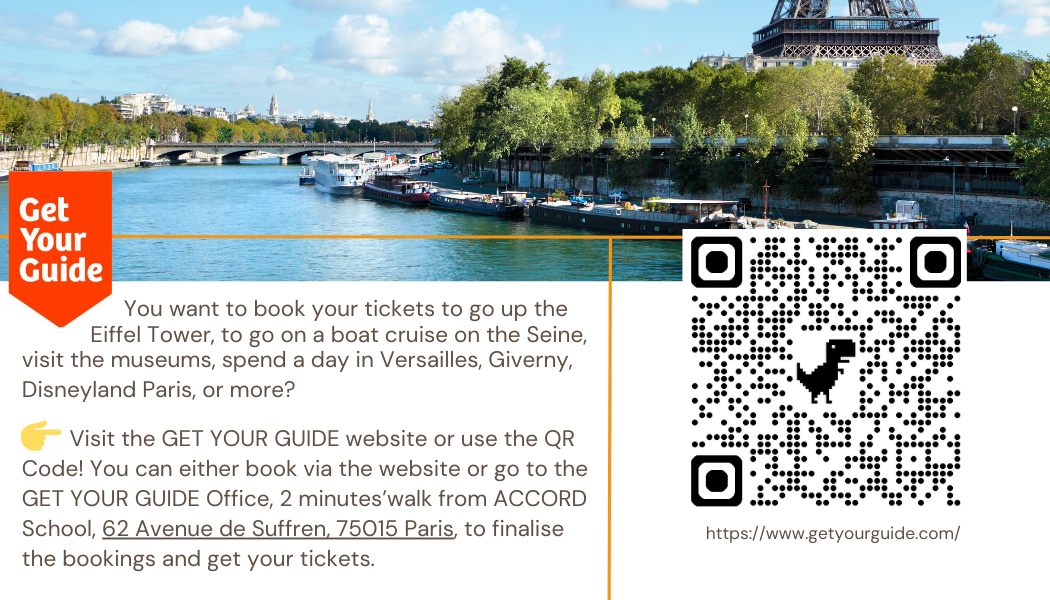
Extra Tip: The partnership established by the ACCORD French language school with the GET YOUR GUIDE agency allows all students of the ACCORD school to participate in the visits and cultural program offered by this agency whose office is located two minutes from the school, 62 avenue de Suffren, in Paris.

Students can, in addition to their French language course, sign up for visits to famous museums or monuments, a cruise on the Seine or the Canal Saint-Martin, an excursion to Giverny, Versailles, Honfleur, or even to Mont Saint-Michel or Disneyland Paris.

Contact ACCORD Paris


Cultural program for ACCORD students

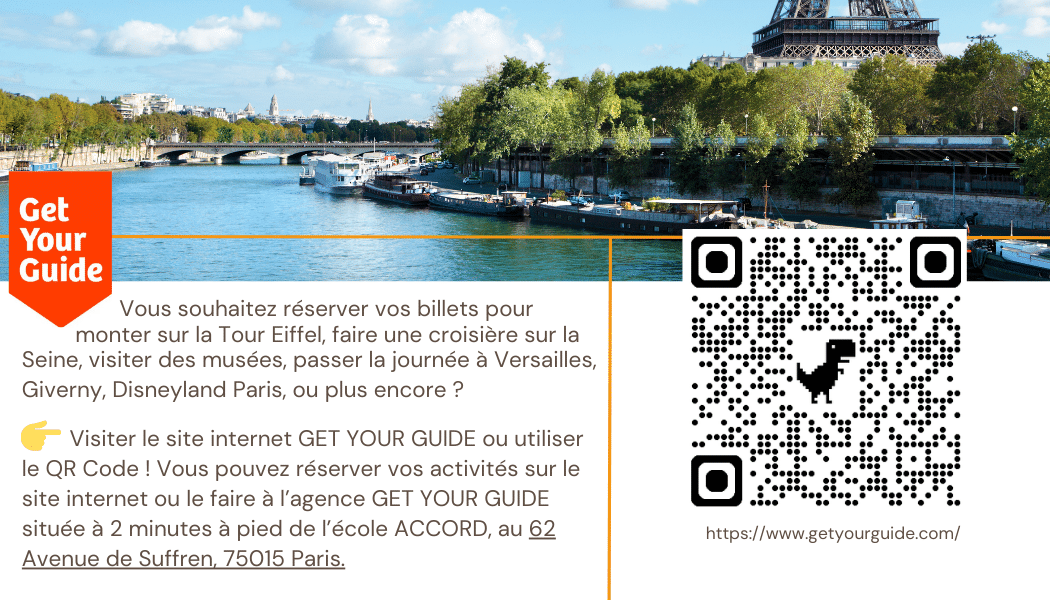
The partnership established by the ACCORD French language school with the GET YOUR GUIDE agency allows all students of the ACCORD school to participate in the visits and cultural program offered by this agency whose office is located two minutes from the school, 62 avenue de Suffren, in Paris.

Students can, in addition to their French course, sign up for visits to famous museums or monuments, a cruise on the Seine or the Canal Saint-Martin, an excursion to Giverny, Versailles, Honfleur, or even to Mont Saint-Michel or Disneyland Paris.

Among the visits and excursions currently offered:

  • Cruise on the Seine departing from the Eiffel Tower, one-hour cruise
  • Disneyland Paris: 1-day ticket
  • Disneyland Paris ticket with transfer
  • Tourist cruise on the Seine with the Bateaux Mouches
  • Hop-on hop-off bus with optional cruise
  • Reserved Access to the Louvre and Boat Cruise
  • Sainte-Chapelle and Conciergerie: Combined tickets
  • Versailles Palace and Gardens: Full Access Ticket
  • Evening cruise on the Seine, with music
  • Entrance ticket to the Opéra Garnier
  • Classical music concert in Saint-Julien-le-Pauvre
  • Dinner show at the Moulin Rouge
  • Tickets for classical music concerts in Parisian churches
  • Entrance tickets to the Musée d’Orsay
  • Guided tour of the Musée d’Orsay with options
  • Cruise on the Saint-Martin canal and the Seine
  • Half-day excursion to Giverny, Monet’s house and gardens
  • Day trip to the gardens of Giverny with a professional guide
  • Honfleur: Private excursion aboard the gardens of Giverny and Honfleur
  • Excursion to Giverny and Versailles with lunch
  • Normandy: Guided tour of the cliffs of Étretat
  • Excursion to Mont-Saint-Michel from Paris
  • …and more…

This partnership between the ACCORD French language school and the GET YOUR GUIDE agency is displayed throughout the school:

To participate in this cultural program, students must be enrolled in a semi-intensive or intensive French course offered by the ACCORD Paris school.

To find out more about our French courses in France: contact our French Language School in Paris.


Numbers and counting in French: surviving the 70-99 nightmare

You’ve learned to count to sixty in French, you feel confident, and then… soixante-dix. Wait, that literally means “sixty-ten”? And it only gets worse from there! If French numbers between 70 and 99 have ever made you freeze mid-sentence, you’re not alone. This part of the language trips up nearly every learner, and there’s a logical (if slightly odd) reason behind it. Let’s break it down so you can finally handle prices, phone numbers and dates without panicking.

Why do French numbers get weird after 69?

Up to soixante-neuf (69), everything follows a clean pattern: dix, vingt, trente, quarante, cinquante, soixante. Each tens unit has its own word. Then France decided to stop inventing new words and started doing math instead.

The reason is historical. French counting kept traces of an old base-20 system (called the vigesimal system), inherited partly from Celtic influence. Instead of creating fresh words for 70, 80 and 90, the language builds them by combining smaller numbers. So you end up literally adding and multiplying out loud every time you say a number in this range. It feels strange at first, but once you see the logic, it stops being random.

The 70s: sixty plus ten

Here’s where the mental gymnastics start. Seventy is “soixante-dix”, literally “sixty-ten.” From there, you keep adding:

  • 71 = soixante et onze (sixty and eleven)
  • 72 = soixante-douze (sixty-twelve)
  • 75 = soixante-quinze (sixty-fifteen)
  • 79 = soixante-dix-neuf (sixty-nineteen)

Notice that 71 keeps the little “et” (and), just like 21, 31, 41, 51 and 61 do. But from 72 onwards, the “et” disappears. This is one of those small details that native speakers do without thinking, and learners tend to overcorrect. Say it out loud a few times and the rhythm sticks faster than you’d expect.

The 80s: four times twenty

If the 70s surprised you, the 80s are where the base-20 logic becomes obvious. Eighty is “quatre-vingts”, literally “four twenties” (4 × 20 = 80). Yes, you’re multiplying now. Then you add units on top:

  • 81 = quatre-vingt-un (four-twenty-one)
  • 85 = quatre-vingt-cinq
  • 89 = quatre-vingt-neuf

One spelling trap worth knowing: quatre-vingts takes an “s” when it’s exactly 80, but loses it as soon as another number follows (quatre-vingt-un, quatre-vingt-deux…). Also, there’s no “et” in eighty-one, it’s just quatre-vingt-un, not “quatre-vingt et un.” Small rule, easy to remember once it clicks.

The 90s: four twenties plus a teenager

By now you can probably guess where this is going. Ninety is “quatre-vingt-dix”, “four-twenty-ten” (80 + 10). To reach the higher nineties, you keep stacking teens onto quatre-vingt:

  • 91 = quatre-vingt-onze (four-twenty-eleven)
  • 95 = quatre-vingt-quinze
  • 99 = quatre-vingt-dix-neuf (four-twenty-nineteen)

So 99 literally translates to “four twenties nineteen.” It looks intimidating written out, but in real conversation it flows quickly. The key is treating “quatre-vingt” as a single block and then adding the teen number after it, exactly like you did in the 70s.

What about Belgium, Switzerland and Quebec?

Here’s some good news that might make you feel better about the whole thing: not all French speakers use this system. In parts of Belgium and Switzerland, people use the far more logical septante (70), and in Switzerland huitante or octante (80) and nonante (90) in some regions. Belgium keeps quatre-vingts for 80 but uses nonante for 90.

So when someone says French counting is illogical, they’re mostly talking about the version used in France. If you ever travel to Geneva or Brussels, you’ll hear cleaner numbers and probably wonder why France made life harder for everyone. That said, if you’re learning standard French for exams like the TCF, you’ll need the soixante-dix/ quatre-vingts system, so it’s worth mastering with French courses for adults in Paris.

How to actually get comfortable with these numbers

Reading the rules is one thing. Using them under pressure, when a cashier tells you a price or someone gives you their phone number, is another. The trick is exposure and repetition in context, not just memorizing tables.

Practise with real-life situations: listen to prices at the market, read phone numbers aloud (French people say them in pairs, like “quatre-vingt-douze” for 92), and count backwards from 100 to force your brain out of autopilot. Speaking the numbers out loud matters far more than reading them silently, because the whole challenge is processing them fast enough to keep up with a conversation. This is exactly the kind of everyday fluency you build in an immersive course in Paris, where you’re surrounded by these numbers all day, in shops, on the metro, in class, until soixante-dix and quatre-vingt-dix-neuf stop feeling like puzzles and start feeling automatic.


French vocabulary for love and friendship

The French have a reputation for romance, and it’s not entirely undeserved. But beyond the clichés of Paris and candlelit dinners, the French language offers a rich vocabulary to talk about affection, from a casual friendship to a passionate love affair. Whether you’re planning to charm someone in French or simply understand your friends better, here’s the vocabulary you actually need.

Talking about friends and friendship

Friendship is a big deal in France, and the word “ami” (male) or “amie” (female) carries real weight. The French don’t hand out the label “ami” easily. Someone you’ve just met is usually a “copain” or “copine”, which sits somewhere between an acquaintance and a friend. 

Be careful though: “mon copain” or “ma copine” often means “my boyfriend” or “my girlfriend” depending on the context!

Here are the essential words to describe your circle:

  • Un(e) ami(e) : a close friend
  • Un(e) copain/copine : a buddy, or a boyfriend/girlfriend
  • Un(e) pote : a mate, very casual and common among young people
  • Un(e) meilleur(e) ami(e) : a best friend
  • Une connaissance : an acquaintance

To say you get along well with someone, use “bien s’entendre avec quelqu’un”. And when you want to express that you appreciate a friend, “tenir à quelqu’un” literally means to care deeply about them.

The many ways to say “I love you”

This is where French gets tricky. The verb “aimer” means both “to like” and “to love”, which causes confusion for learners. Context and intensity make all the difference.

Say “je t’aime” to someone and you’re declaring love, plain and simple. But add “bien” and everything changes: “je t’aime bien” actually means “I like you” in a friendly way. So never tell your crush “je t’aime bien” thinking you’re being romantic, because you’ll come across as putting them in the friend zone. To love someone deeply, you can go further with “je t’adore” or the very strong “je suis fou/folle de toi” (I’m crazy about you).

Terms of endearment the French really use

French couples throw around pet names constantly, and some of them are honestly strange when translated. Don’t overthink the logic, just enjoy them.

  • Mon chéri / ma chérie : my darling
  • Mon amour : my love
  • Mon coeur : my heart
  • Mon chou : literally “my cabbage” (but also a cream puff pastry)
    Ma puce : “my flea”, used affectionately with partners and kids
  • Mon trésor : my treasure

Yes, calling your partner a cabbage or a flea sounds bizarre, but these are among the most common terms of endearment in everyday French. Regional and family variations exist too, so don’t be surprised to hear even odder ones.

Vocabulary for dating and relationships

If you’re navigating the French dating scene, a few key expressions will help. To flirt is “draguer”, and someone who flirts a lot is a “dragueur” or “dragueuse”. When two people start dating, they say they are “ensemble” (together) or that they “sortent ensemble” (they’re going out).

Falling for someone is “tomber amoureux” (male) or “tomber amoureuse” (female). That first spark, love at first sight, has a beautiful French name: “le coup de foudre”, literally “a bolt of lightning”. When things get serious, a couple might “se fiancer” (get engaged) and eventually “se marier” (get married). And if things go wrong, they “rompre” (break up) or “se séparer”.

Expressing emotions and affection

Beyond declarations, you’ll want words to describe how you feel. “Manquer” is one of the trickiest verbs here because it works backwards compared to English. To say “I miss you”, the French say “tu me manques”, which literally translates to “you are missing to me”. It takes some getting used to.

Other useful expressions include “avoir le béguin pour quelqu’un” (to have a crush on someone), “être attiré(e) par” (to be attracted to), and “faire un câlin” (to cuddle or give a hug). When you’re touched by a friend’s gesture, you can say “ça me touche” (that moves me) or “tu comptes beaucoup pour moi” (you mean a lot to me).

Why learning this vocabulary matters

Words about love and friendship aren’t just textbook material, they’re at the heart of real conversations. You’ll hear them in films, songs, on the street and among friends far more often than you’ll ever discuss grammar rules. Mastering the nuance between “je t’aime” and “je t’aime bien” can genuinely save you from an awkward moment.

At ACCORD French Language School in the heart of Paris, our courses go beyond the basics to help you speak French the way people actually do, with all its warmth and subtlety. Whether through our intensive French courses for adults or a full French language immersion in Paris, learning the living language means learning how to connect with people, and that starts with knowing the right words for the ones you care about.


Common swear words and interjections in French

Learning French from a textbook is one thing. Understanding what your Parisian neighbor mutters when he stubs his toe is another! Swear words and interjections are everywhere in daily French life, from casual chats between friends to films, songs, and heated arguments. Whether you want to understand them or use them (carefully), this guide walks you through the expressions that never make it into formal lessons.

Why interjections matter in real conversations

Textbook French teaches you to say “je suis surpris” (I am surprised). Real French people just say “Ah bon?”, “Sérieux?” or “Vrai?”. Interjections are the shortcuts native speakers use to react instantly, and they carry a lot of emotional weight in very few syllables.

Ignoring them means you’ll sound stiff and slightly robotic, even with perfect grammar. Picking them up, on the other hand, makes your French feel alive. You’ll catch the tone of a conversation faster and react like someone who actually lives the language rather than someone reciting it.

The mild interjections you’ll hear everywhere

Some French exclamations are perfectly acceptable in almost any setting. These are the ones you can use with colleagues, teachers, or your host family without raising an eyebrow. They express surprise, frustration, agreement, or hesitation.

  • Oh là là… : The classic. It expresses surprise, admiration, or dismay depending on the tone.
  • Bof : A shrug in word form. Means total indifference.
  • Aïe : The French “ouch,” used for physical or emotional pain.
  • Beurk : Disgust.
  • Ouf : Relief, like “phew.” Also slang (verlan) for “crazy” in another context.
  • Hein? : “What?”, used to ask for repetition or express disbelief.

These small words do a lot of heavy lifting. Master them and you’ll immediately sound more natural, even if your vocabulary is still limited.

The everyday swear words French people use

French swearing is a category of its own. Some words are strong, others are so common they’ve almost lost their punch. The undisputed champion is “putain”, literally an insult but used constantly to express frustration, surprise, admiration, or just as verbal filler. You’ll hear it a hundred times a day in France, often without any real aggression behind it.

Right behind it comes “merde” (shit), which works exactly like its English counterpart. Interestingly, telling an actor or a student “merde!” is actually a way to wish them good luck, the French version of “break a leg.” Then there’s “con” and “connard/ connasse” (idiot, jerk), which range from playful teasing between friends to genuine insults depending entirely on tone and context.

Combinations and reinforced expressions

The French love to stack their swear words for extra emphasis. You will ll hear “j’en ai marre” or the stronger “j’en ai ras le bol”, both meaning “I’m fed up,” with the second being a bit more colourful.

When and where you can actually use them

Here’s the tricky part. Just because you understand these words doesn’t mean you should throw them around freely. Context is everything in French. Dropping a “putain” with close friends over a beer is normal. Saying it in a job interview or in front of your host grandmother is a disaster.

As a rule, keep swearing out of any formal, professional, or unfamiliar situation. Listen first, observe how people around you speak, and mirror their register. The safest approach for a learner is to recognize these words so you understand what’s happening, and to use only the mildest interjections until you have a solid feel for social nuance. 

If you’re staying with a host family through a French course and family homestay, this kind of social awareness becomes especially useful day to day.

How French films and music teach you the real language

If you want to absorb natural spoken French, screens and songs are your best friends. French cinema is full of authentic dialogue where interjections and swear words appear exactly as they do in life. Comedies especially, like the films of Dany Boon or older classics, give you a real ear for tone and timing.

Rap and pop music are equally useful. Artists don’t censor themselves, so you hear slang and profanity in a natural rhythm. The goal isn’t to memorize a list but to feel how these words are actually delivered, with what emotion and in which situations. That instinct is exactly what separates a fluent speaker from a fluent-on-paper one, and it’s the kind of thing you develop faster by immersing yourself in French, ideally through a French language immersion in Paris program, or with dedicated French courses for adults in Paris, surrounded by the language every single day.


Learn Parisian Slang (So you don’t sound like a tourist!)

You’ve spent months learning French. You can conjugate verbs, order a coffee, ask for directions. Then you land in Paris, and someone tells you they’re going to “bosser” before they “bouffent un truc“, and you’re completely lost. Welcome to the gap between textbook French and how Parisians actually talk. Here’s the slang that’ll help you blend in instead of standing out like a lost tourist clutching a map.

Why French textbooks won’t save you in Paris

Classroom French teaches you the correct, polished version of the language. It’s essential, you need that foundation. But it won’t prepare you for a real conversation in a Paris café or on the metro, where locals speak fast, drop words, and lean heavily on argot (slang).

The truth is, Parisians don’t talk like a grammar exercise. They shorten words, swap in slang terms, and use expressions you’ll never find in your school book. Knowing a bit of everyday vocabulary makes you sound natural, and it shows locals you’ve made the effort to understand their Paris, not just the tourist version.

The everyday words you’ll hear constantly

Some slang words are so common that Parisians use them without even thinking. If you only learn a handful of expressions, make it these, they’ll come up in almost every casual conversation.

  • Bosser, to work (instead of travailler)
  • Bouffer, to eat (a very casual version of manger)
  • Un truc, a thing / a whatchamacallit
  • Le boulot, work or the workplace (je vais au boulot)

Drop one of these naturally into a conversation and watch how the tone shifts. Suddenly you’re not the tourist asking questions, you’re someone who actually gets how people talk here.

Verlan: the slang that flips words around

If there’s one thing that confuses foreigners more than anything, it’s verlan. This is a form of slang where syllables are reversed. The word “verlan” itself comes from l’envers (backwards), flipped around. It sounds like a puzzle, but once you spot the pattern, you’ll start recognizing it everywhere.

A few classics: relou from lourd (annoying/heavy), and ouf from fou (crazy). When a Parisian says something was “un truc de ouf,” they mean it was insane, in a good way. You don’t need to speak verlan fluently, but understanding it will stop you from freezing up when a conversation takes an unexpected turn.

Words to sound relaxed, not stiff

Formal French can make you sound like you’re reading from a manual. A few casual expressions instantly loosen up your speech and make you seem more at ease, which is exactly how Parisians talk among friends.

Instead of saying oui all the time, you’ll hear ouais (yeah). Money isn’t argent, it’s du fric or du pognon. A car is une caisse, a phone is un tel (short for téléphone), and when something is expensive, Parisians say “il coûte un bras“, it costs an arm.
And that friend you’re meeting? They’re not your
ami, they’re your pote.

The key is not to overdo it. Sprinkle these in naturally. Nobody trusts a foreigner who suddenly speaks nothing but slang, it sounds forced. A word or two at the right moment is all it takes.

Expressions that reveal you know the city

Beyond individual words, Parisians rely on set phrases that carry a lot of meaning. These are the expressions that separate someone who studied French from someone who’s actually lived the language.

J’en peux plus” means I can’t take it anymore, perfect for a long metro ride. “C’est chaud” literally means “it’s hot,” but really means something is difficult or intense. “Laisse tomber” means forget it, drop it. And “Ça marche“, literally “it walks”, is how Parisians say “sounds good” or “that works.” You’ll hear that last one dozens of times a day.

How to actually pick up Parisian slang

You can memorize word lists all day, but slang only sticks when you hear it in context and use it out loud. That’s why immersion beats any app. Listening to how people speak on the terrace, in shops, on the street, that’s where the real learning happens.

At ACCORD French Language School, right in the heart of Paris near the Eiffel Tower, you learn French the way it’s actually spoken. Our intensive and semi-intensive courses combine solid grammar with the everyday language you’ll use the moment you step outside. Whether you’re here for a few weeks or preparing for an official exam like the TCF or the DELF, you’ll leave sounding less like a tourist and more like someone who belongs. And that, honestly, is the whole point of learning a language in the first place.


French tips: ordering at a restaurant like a local

Sitting down at a Parisian café and ordering in French sounds easy until the waiter shows up and you blank. The truth is, ordering like a local has less to do with perfect grammar and more with knowing the right phrases, the right rhythm, and a few unspoken rules. Get these down, and you’ll stop sounding like a tourist reading from a phrasebook. Here’s how to handle a French restaurant like you actually live here.

Getting the waiter’s attention without being rude

Forget snapping your fingers or shouting “garçon!” like in old movies. French waiters find that genuinely offensive, and it marks you as a clueless tourist instantly. The real move is simple: catch their eye, give a small nod, and say a polite “Excusez-moi” or “S’il vous plaît” when they pass by.

Patience matters more than you’d expect. In France, the waiter won’t hover or rush you, and that’s intentional. Your table is yours for the evening, so nobody is trying to flip it for the next customer. If you need them, a calm raised hand and eye contact does the job. Push too hard and you’ll get slower service, not faster.

The phrases you actually need

You don’t need a huge vocabulary to sound natural. A handful of expressions covers most situations, and locals use them constantly:

  • “Je vais prendre…” (I’ll have…), the standard way to order
    “Qu’est-ce que vous me conseillez ?” (What do you recommend?), asks for the waiter’s pick
    “Pour moi, ce sera…” (For me, it’ll be…), a slightly more casual order
    “L’addition, s’il vous plaît” (The bill, please), to wrap things up
  • “C’était délicieux” (It was delicious), a nice touch before you leave

The key is starting with “Bonjour” before anything else. Walking up and launching straight into your order without a greeting is considered abrupt in France. Say “Bonjour” first, then make your request. That single word changes how you’re treated.

Understanding the menu structure

A French menu follows a logic: entrée (starter), plat (main course), and dessert. Be careful here, because “entrée” does not mean the main dish like it does in American English. It’s the appetizer. Mixing this up is one of the most common slip-ups.

You’ll also see “formule” or “menu” on the board, which means a fixed-price set of courses, usually cheaper than ordering each plate separately. A “plat du jour” is the dish of the day, often the freshest and best value. Locals order these without thinking twice, and so should you.

How the French actually drink at the table

Water is a small ritual. If you ask for “de l’eau,” you might get bottled water you pay for. Want the free tap water? Ask for “une carafe d’eau”, it’s perfectly normal and nobody judges you for it. This alone saves you money on every meal.

Wine works differently too. You can order it “au verre” (by the glass), “en pichet” (a small carafe, very common and casual), or “à la bouteille” (full bottle). Ordering a pichet of house wine is a deeply local move, and it’s usually solid quality without the markup. Coffee comes after dessert, never during the meal, order it before and you’ll get a puzzled look.

Tipping and paying the right way

Here’s good news: service is already included in France. The price you see is the price you pay, and the staff are paid a real wage. You’re never obligated to tip, which trips up a lot of visitors from countries where tipping is mandatory.

That said, leaving a little is appreciated for good service. Rounding up or dropping a couple of euros on the table is the standard gesture. When you want to pay, say “L’addition, s’il vous plaît.” Note that the bill won’t come automatically, bringing it before you ask would feel like the staff are kicking you out. You have to request it.

Small habits that give you away

A few details separate locals from visitors. The French rarely ask for substitutions or changes to a dish; they take it as the chef intended. They also don’t rush, a meal is a moment, not a transaction. Eating quickly and leaving fast is the opposite of the French approach.

Bread is another tell. It comes free, it sits directly on the table (not on a plate), and you tear off pieces rather than biting into the whole thing. Using bread to mop up sauce at the end is totally accepted, even encouraged. These tiny habits, once you adopt them, make you blend in far more than your accent ever will.

Learning these reflexes comes naturally when you spend time in the city and practice with real people. If you want to fully immerse yourself, staying with a host family through a French course and family homestay can accelerate how quickly these habits become second nature. At ACCORD French Language School, near the Eiffel Tower in Paris, our French courses for adults in Paris go beyond grammar, they prepare you for the everyday French moments that actually matter, from ordering dinner to chatting with the waiter like you’ve lived here for years. For those who want to go even deeper, a full French language immersion program in Paris is the fastest way to pick up these local reflexes for good.


Spoken vs written French: why the difference?

You’ve spent months learning French grammar: you can write a clean paragraph, conjugate verbs without breaking a sweat, and then a Parisian opens their mouth and you understand nothing

Sound familiar? Spoken French and written French often feel like two separate languages, and that gap trips up almost every learner. Here’s why it happens, and how to bridge it.

Two registers that don’t always match

French has a strong divide between what’s written and what’s actually said in daily life. The written form sticks closely to the rules you learn in textbooks: full sentences, complete negations, formal vocabulary. The spoken form follows its own logic. People drop words, swallow syllables, and reshuffle sentence structure constantly.

This isn’t laziness or “bad French.” It’s just how the language lives in real conversations. A French person writing a professional email and the same person chatting with friends are using two different gears. Learners who only study the written version arrive in France ready for one and slammed with the other.

The disappearing “ne”

The clearest example is negation. In writing, you’d never skip the “ne” in a negative sentence. “Je ne sais pas” is correct and complete. But listen to actual conversation and you’ll hear “Je sais pas” almost every single time. The “ne” simply vanishes.

This one habit confuses beginners enormously. You’ve memorized the ne… pas structure, you’re listening for it, and it’s not there. The same goes for “il y a”, which often becomes “y’a”, or “je ne sais pas” collapsing into something that sounds like “chais pas”. Once you know these shortcuts exist, your ear adjusts fast.

Pronunciation eats whole sounds

French pronunciation is famous for dropping letters and merging words together. Final consonants are usually silent, vowels link from one word to the next, and the “e” at the end of words often disappears in casual speech. The result is a smooth, fast flow that bears little resemblance to the neat written line on the page.

Take a phrase like “Qu’est-ce que tu fais ?” On paper it’s five distinct words. Spoken quickly, it sounds more like “kesketufé”, one blurred chunk. This is why students who read well still struggle to follow conversations. The sounds don’t break apart the way the spelling suggests.

Vocabulary and slang in everyday speech

Spoken French leans on a whole layer of vocabulary you rarely see in formal writing. Casual and slang terms fill everyday conversation, and many of them never appear in your coursebook. A few examples you’ll hear constantly:

  • “un truc” instead of “une chose” (a thing)
  • “bosser” instead of “travailler” (to work)
  • “un mec” or “une meuf” for a guy or a girl
  • “ouais” instead of “oui” (yeah)

Then there’s verlan, a form of slang that reverses syllables, plus borrowed English words used in unexpected ways. None of this is wrong, but it means the written language you study and the spoken one you hear can feel worlds apart until you’ve spent real time immersed in conversation.

Sentence structure loosens up

Written French follows a fairly rigid word order. Questions get inverted, clauses connect cleanly, everything has its place. Spoken French breaks these rules freely. Instead of the formal inversion “Veux-tu un café ?”, people just say “Tu veux un café ?” with a rising tone. The question mark lives in the voice, not the grammar.

You’ll also hear sentences that restate the subject for emphasis, like “Moi, je pense que…” or “Ce film, je l’ai pas aimé.” These constructions sound clumsy in writing but are completely natural in speech. Getting comfortable with them is a big part of sounding fluent rather than bookish.

How to close the gap between the two

The good news: this divide is normal, and every learner faces it. The fix isn’t more grammar drills, it’s exposure to real spoken French. Watch French films and series without dubbing, listen to podcasts and radio, and most importantly, talk with native speakers as much as you can. Your ear needs to hear how words actually merge and shrink in real time.

This is where structured immersion makes the difference. At ACCORD French Language School in central Paris, classes for adults combine solid written foundations with the spoken French you’ll use the moment you step outside. 

Living with a French family homestay and practicing daily turns that intimidating gap into something you barely notice. The two versions of French stop competing and start working together.