
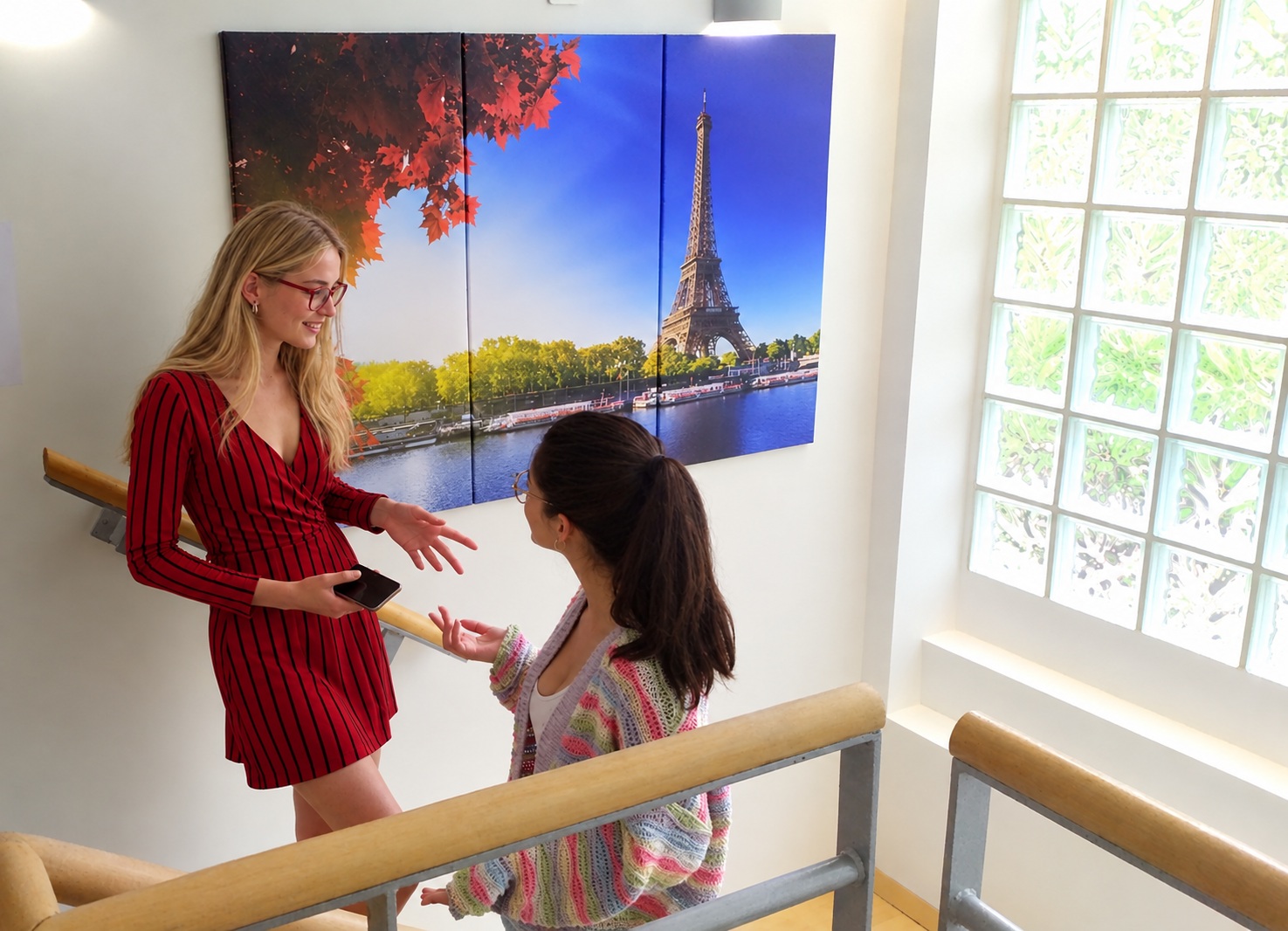
Talking About Time in French: From Centuries to Minutes
Time flies, and in French it flies in some very useful phrases. Knowing how to talk about time can be the difference between catching your train or airplane and watching it leave without you. It also helps with booking a table in a Parisian brasserie, making plans with a classmate or turning up on the right day for your French course in France.
This guide goes from the biggest units of time (eras and years) down to the smallest (hours, minutes and seconds). Each section has the key vocabulary and a few examples you can use right away.
Eras, centuries and years in French
Let’s start big. These expressions are perfect for talking about history, memories and how quickly life moves.
- une époque / à l’époque: an era / back then, at the time
- de nos jours / à notre époque: nowadays
- au temps de… : at the time of…
- un siècle: a century
- une décennie / des décennies: a decade / decades
- cent ans: one hundred years
- une centaine d’années: about a hundred years
- des centaines d’années: hundreds of years
Examples:
- À l’époque, on écrivait des lettres. (Back then, people wrote letters.)
- De nos jours, tout va très vite. (Nowadays, everything moves fast.)
- Cette cathédrale a des centaines d’années. (This cathedral is hundreds of years old.)
Un an or une année?
Both mean “year”, but they are not interchangeable.
- Un an is used with a number or for counting: J’ai vingt-cinq ans. (I’m 25)
- Une année emphasises the length or content of the year: Ce fut une très bonne année. (It was a very good year.) Il fait beau toute l’année. (The weather’s nice all year round.)
Saying a year out loud
French says years as full numbers, just like English does for years such as “two thousand and twenty-six”:
- en deux mille vingt-six (in 2026)
- en mille neuf cent quatre-vingt-dix-huit (in 1998)
Talking about the passing of time
- Il y a (très) longtemps – a (very) long time ago
- Au fil du temps – over time
- Les années passent vite ! – The years fly by!
- Le temps passe lentement. – Time is passing slowly.
The four seasons in French
Notice that each season takes a different little word for “in”: au for spring, en for the other three.
- le printemps: spring
- l’été: summer
- l’automne: autumn / fall
- l’hiver: winter
Many learners say “à l’automne”, but “en automne” is the standard form.
Example: J’adore voyager en été, mais je préfère skier en hiver. (I love travelling in summer, but I prefer skiing in winter.)
The months of the year in French
- janvier: January
- février: February
- mars: March
- avril: April
- mai: May
- juin: June
- juillet: July
- août: August
- septembre: September
- octobre: October
- novembre: November
- décembre: December
To say “in” a month, use en or au mois de:
- Mon anniversaire est en mai. (My birthday is in May.)
- Nous partons en vacances au mois d’août. (We’re going on holiday in August.)
Small words that make a big difference
- un mois – a month
- chaque mois / tous les mois – every month
- le mois prochain – next month
- le mois dernier – last month
- à la fin du mois – at the end of the month
The days of the week in French
- lundi: Monday
- mardi: Tuesday
- mercredi: Wednesday
- jeudi: Thursday
- vendredi: Friday
- samedi: Saturday
- dimanche: Sunday
Tip 1: no capital letters!
In French, days and months are written in lower case unless they start a sentence. Capitals are kept for proper nouns, such as people, places and organisations. That’s why it’s la France but le français, and lundi but not Lundi.
Tip 2: “lundi” vs “le lundi”
This small detail makes you sound much more natural:
- lundi (no article) = this coming Monday, or last Monday
On se voit lundi. (See you on Monday.) - le lundi = every Monday
Le lundi, je vais à mon cours de français. (On Mondays, I go to my French class.)
Week vocabulary
- une semaine / dans une semaine – a week / in a week
- le week-end – the weekend
- un jour / une journée – a day / the whole day (with its activities and duration)
Example: J’ai passé une belle journée à Paris. (I spent a lovely day in Paris.) We say une journée here because we are talking about the whole day, not just counting it.
Today, tomorrow, yesterday: relative time expressions
These are the words you’ll use every single day.
- aujourd’hui: today
- demain: tomorrow
- après-demain: the day after tomorrow
- hier: yesterday
- avant-hier: the day before yesterday
- la veille: the day before / the eve
- le lendemain: the next day
Examples:
- Demain matin, j’ai un rendez-vous. (Tomorrow morning, I have an appointment.)
- Hier soir, nous avons dîné au restaurant. (Last night, we had dinner at a restaurant.)
- Le lendemain, il pleuvait. (The next day, it was raining.)
How to give the date in French
Two useful questions to start with:
- Quel jour sommes-nous ? or On est quel jour ? – What day is it?
- Quelle est la date aujourd’hui ? – What’s the date today?
The pattern: day of the week + number + month.
- Aujourd’hui, on est le lundi 12 octobre. (Today is Monday the 12th of October.)
- Samedi prochain, on sera le 17 octobre. (Next Saturday will be the 17th of October.)
The “premier” rule: only the first of the month uses an ordinal (le 1er, from premier). All the other dates use ordinary numbers.
- Le 1er novembre (le premier novembre)
- Le 14 juillet (le quatorze juillet), France’s national day
- Le 25 décembre (le vingt-cinq décembre), Christmas Day
You may also come across these useful tools for planning your time: un calendrier (a calendar), un agenda (a diary) and un planning (a schedule).
Parts of the day in French
- à l’aube: at dawn
- le matin / toute la matinée: the morning / the whole morning
- midi: midday / noon
- un (ou une) après-midi: an afternoon
- au coucher du soleil: at sunset
- le soir / la soirée: the evening / the whole evening
- la nuit: the night
- minuit: midnight
Important Tip: Après-midi is one of the rare nouns that can be either masculine or feminine, so un après-midi and une après-midi are both correct.
Greetings and goodbyes that use time words
The French adapt their greetings to the time of day, and the “goodbye” versions are very useful:
- Bonjour – hello (during the day)
- Bonne journée ! – Have a good day!
- Bonsoir – good evening (as a greeting)
- Bonne soirée ! – Have a nice evening!
- Bonne nuit – good night (when going to bed)
Hours, minutes and seconds
- une heure / dans une heure: an hour / in an hour
- un quart d’heure: a quarter of an hour
- une demi-heure: half an hour
- une minute: a minute
- une seconde / en quelques secondes: a second / in a few seconds
Examples:
- Le film dure une heure et demie. (The film lasts an hour and a half.)
- Je reviens dans cinq minutes. (I’ll be back in five minutes.)
How to tell the time in French
Start with the question:
- Quelle heure est-il ? – What time is it?
And answer with: Il est… heures.
- Il est une heure : It’s one o’clock.
- Il est une heure et quart: It’s a quarter past one.
- Il est quatre heures et demie: It’s half past four.
- Il est huit heures vingt: It’s twenty past eight.
- Il est trois heures moins le quart: It’s a quarter to three.
- Il est midi moins cinq: It’s five to twelve (noon).
- Il est minuit et demi: It’s half past midnight.
Important Tip: heure is feminine, so it’s quatre heures et demie. But midi and minuit are masculine, so it’s midi et demi.
Adding “morning”, “afternoon” or “evening”:
- Il est huit heures du matin. (It’s 8 in the morning.)
- Il est huit heures du soir. (It’s 8 in the evening.)
Asking and answering “at what time?”:
- À quelle heure part le train ? – What time does the train leave?
- Il part à quatorze heures trente-cinq. – It leaves at 14:35 (2:35pm).
The 24-hour clock: the golden rules
Rule 1 – The French usually use the 24-hour clock:
8pm is vingt heures (20h). In everyday conversation you can still say huit heures du soir, which is perfectly fine. Just huit heures on its own is ambiguous, but most people will assume you mean 8am.
Rule 2 – Write times in the 24-hour format too:
Where an English speaker writes 8.10pm, the French write 20h10. 7.40am becomes 7h40. Notice that the “h” replaces the colon or full stop.
Rule 3 – Don’t mix the two systems:
You can’t say seize heures et quart, because that blends the 24-hour clock (seize = 16) with the 12-hour “et quart”. Choose one:
- ✅ seize heures quinze (16:15)
- ✅ quatre heures et quart de l’après-midi (a quarter past four in the afternoon)
Quick recap: your time-talking cheat sheet
- Use en for months and most seasons (au printemps), and au mois de to be more precise.
- Keep days and months in lower case.
- lundi = this Monday, le lundi = every Monday.
- The first of the month is le 1er, the rest are plain numbers.
- Tell the time with Il est… heures, and expect the 24-hour clock.
- Never mix 24-hour and 12-hour expressions in the same sentence.
Ready to practise your French in France?
Now you have everything you need to make plans, catch your plane or your train and arrive on time. We wish you une très belle journée and hope to see you start your course at the ACCORD French Language School in Paris at 9am on Monday morning.
If you’ve booked an intensive French course with afternoon lessons, those begin at 14:00 (2pm). Don’t be late!
