
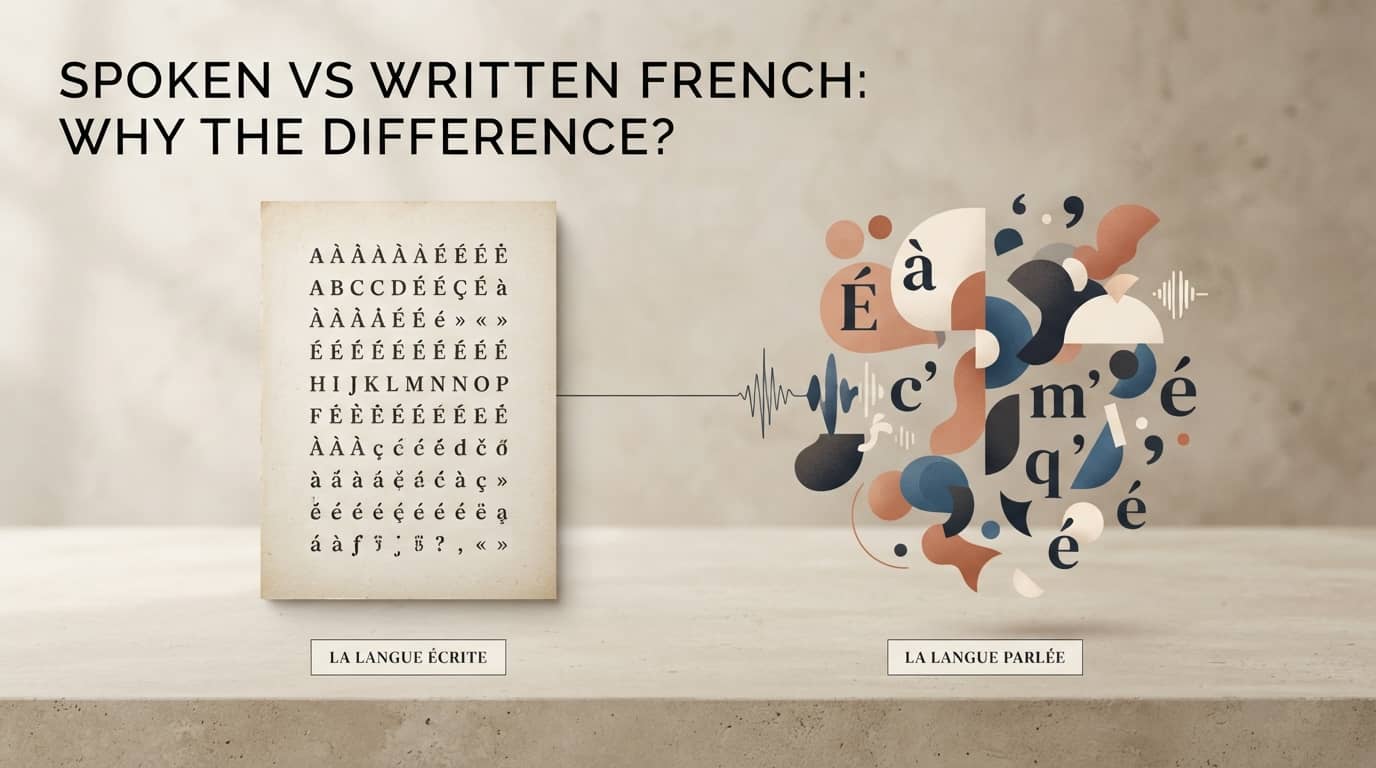
You’ve spent months learning French grammar: you can write a clean paragraph, conjugate verbs without breaking a sweat, and then a Parisian opens their mouth and you understand nothing.
Sound familiar? Spoken French and written French often feel like two separate languages, and that gap trips up almost every learner. Here’s why it happens, and how to bridge it.
Two registers that don’t always match
French has a strong divide between what’s written and what’s actually said in daily life. The written form sticks closely to the rules you learn in textbooks: full sentences, complete negations, formal vocabulary. The spoken form follows its own logic. People drop words, swallow syllables, and reshuffle sentence structure constantly.
This isn’t laziness or “bad French.” It’s just how the language lives in real conversations. A French person writing a professional email and the same person chatting with friends are using two different gears. Learners who only study the written version arrive in France ready for one and slammed with the other.
The disappearing “ne”
The clearest example is negation. In writing, you’d never skip the “ne” in a negative sentence. “Je ne sais pas” is correct and complete. But listen to actual conversation and you’ll hear “Je sais pas” almost every single time. The “ne” simply vanishes.
This one habit confuses beginners enormously. You’ve memorized the ne… pas structure, you’re listening for it, and it’s not there. The same goes for “il y a”, which often becomes “y’a”, or “je ne sais pas” collapsing into something that sounds like “chais pas”. Once you know these shortcuts exist, your ear adjusts fast.
Pronunciation eats whole sounds
French pronunciation is famous for dropping letters and merging words together. Final consonants are usually silent, vowels link from one word to the next, and the “e” at the end of words often disappears in casual speech. The result is a smooth, fast flow that bears little resemblance to the neat written line on the page.
Take a phrase like “Qu’est-ce que tu fais ?” On paper it’s five distinct words. Spoken quickly, it sounds more like “kesketufé”, one blurred chunk. This is why students who read well still struggle to follow conversations. The sounds don’t break apart the way the spelling suggests.
Vocabulary and slang in everyday speech
Spoken French leans on a whole layer of vocabulary you rarely see in formal writing. Casual and slang terms fill everyday conversation, and many of them never appear in your coursebook. A few examples you’ll hear constantly:
- “un truc” instead of “une chose” (a thing)
- “bosser” instead of “travailler” (to work)
- “un mec” or “une meuf” for a guy or a girl
- “ouais” instead of “oui” (yeah)
Then there’s verlan, a form of slang that reverses syllables, plus borrowed English words used in unexpected ways. None of this is wrong, but it means the written language you study and the spoken one you hear can feel worlds apart until you’ve spent real time immersed in conversation.
Sentence structure loosens up
Written French follows a fairly rigid word order. Questions get inverted, clauses connect cleanly, everything has its place. Spoken French breaks these rules freely. Instead of the formal inversion “Veux-tu un café ?”, people just say “Tu veux un café ?” with a rising tone. The question mark lives in the voice, not the grammar.
You’ll also hear sentences that restate the subject for emphasis, like “Moi, je pense que…” or “Ce film, je l’ai pas aimé.” These constructions sound clumsy in writing but are completely natural in speech. Getting comfortable with them is a big part of sounding fluent rather than bookish.
How to close the gap between the two
The good news: this divide is normal, and every learner faces it. The fix isn’t more grammar drills, it’s exposure to real spoken French. Watch French films and series without dubbing, listen to podcasts and radio, and most importantly, talk with native speakers as much as you can. Your ear needs to hear how words actually merge and shrink in real time.
This is where structured immersion makes the difference. At ACCORD French Language School in central Paris, classes for adults combine solid written foundations with the spoken French you’ll use the moment you step outside.
Living with a French family homestay and practicing daily turns that intimidating gap into something you barely notice. The two versions of French stop competing and start working together.
