
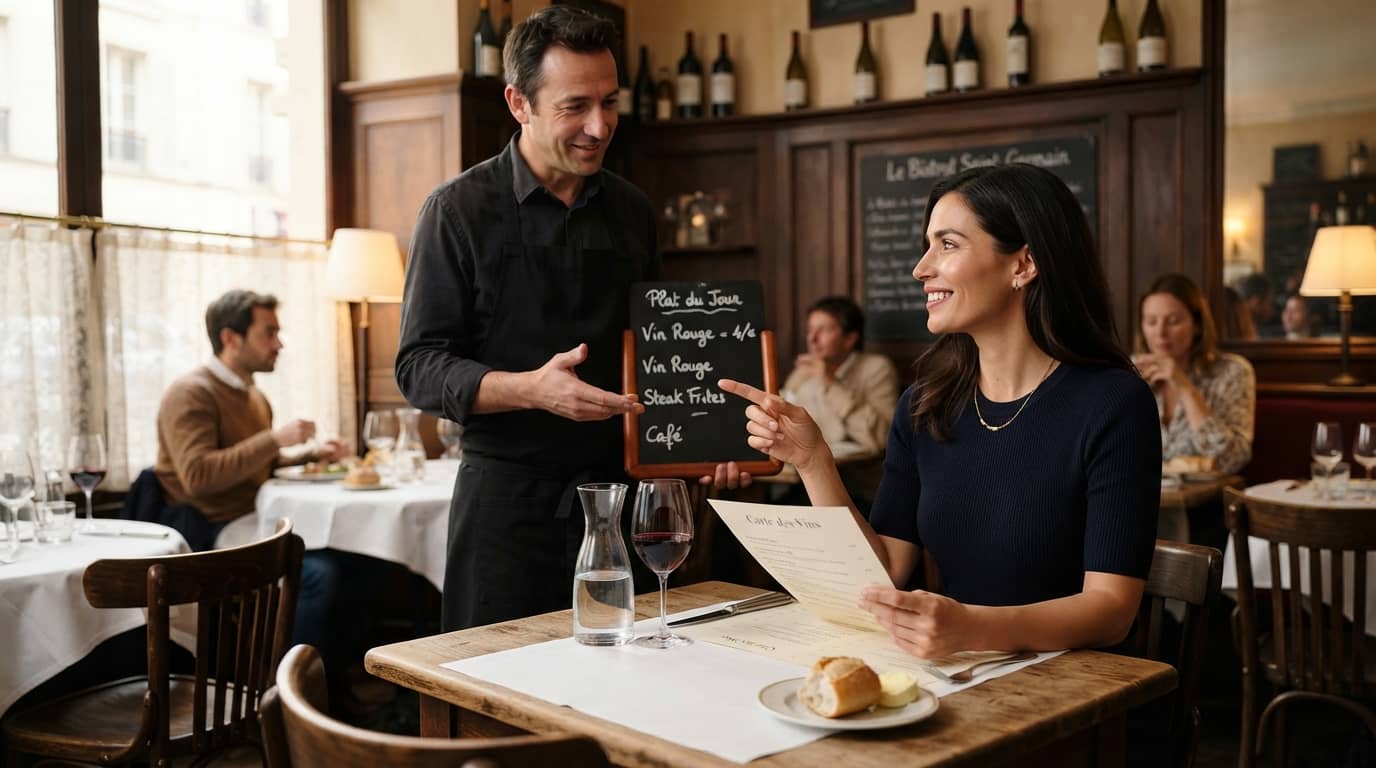
Sitting down at a Parisian café and ordering in French sounds easy until the waiter shows up and you blank. The truth is, ordering like a local has less to do with perfect grammar and more with knowing the right phrases, the right rhythm, and a few unspoken rules. Get these down, and you’ll stop sounding like a tourist reading from a phrasebook. Here’s how to handle a French restaurant like you actually live here.
Getting the waiter’s attention without being rude
Forget snapping your fingers or shouting “garçon!” like in old movies. French waiters find that genuinely offensive, and it marks you as a clueless tourist instantly. The real move is simple: catch their eye, give a small nod, and say a polite “Excusez-moi” or “S’il vous plaît” when they pass by.
Patience matters more than you’d expect. In France, the waiter won’t hover or rush you, and that’s intentional. Your table is yours for the evening, so nobody is trying to flip it for the next customer. If you need them, a calm raised hand and eye contact does the job. Push too hard and you’ll get slower service, not faster.
The phrases you actually need
You don’t need a huge vocabulary to sound natural. A handful of expressions covers most situations, and locals use them constantly:
- “Je vais prendre…” (I’ll have…), the standard way to order
“Qu’est-ce que vous me conseillez ?” (What do you recommend?), asks for the waiter’s pick
“Pour moi, ce sera…” (For me, it’ll be…), a slightly more casual order
“L’addition, s’il vous plaît” (The bill, please), to wrap things up - “C’était délicieux” (It was delicious), a nice touch before you leave
The key is starting with “Bonjour” before anything else. Walking up and launching straight into your order without a greeting is considered abrupt in France. Say “Bonjour” first, then make your request. That single word changes how you’re treated.
Understanding the menu structure
A French menu follows a logic: entrée (starter), plat (main course), and dessert. Be careful here, because “entrée” does not mean the main dish like it does in American English. It’s the appetizer. Mixing this up is one of the most common slip-ups.
You’ll also see “formule” or “menu” on the board, which means a fixed-price set of courses, usually cheaper than ordering each plate separately. A “plat du jour” is the dish of the day, often the freshest and best value. Locals order these without thinking twice, and so should you.
How the French actually drink at the table
Water is a small ritual. If you ask for “de l’eau,” you might get bottled water you pay for. Want the free tap water? Ask for “une carafe d’eau”, it’s perfectly normal and nobody judges you for it. This alone saves you money on every meal.
Wine works differently too. You can order it “au verre” (by the glass), “en pichet” (a small carafe, very common and casual), or “à la bouteille” (full bottle). Ordering a pichet of house wine is a deeply local move, and it’s usually solid quality without the markup. Coffee comes after dessert, never during the meal, order it before and you’ll get a puzzled look.
Tipping and paying the right way
Here’s good news: service is already included in France. The price you see is the price you pay, and the staff are paid a real wage. You’re never obligated to tip, which trips up a lot of visitors from countries where tipping is mandatory.
That said, leaving a little is appreciated for good service. Rounding up or dropping a couple of euros on the table is the standard gesture. When you want to pay, say “L’addition, s’il vous plaît.” Note that the bill won’t come automatically, bringing it before you ask would feel like the staff are kicking you out. You have to request it.
Small habits that give you away
A few details separate locals from visitors. The French rarely ask for substitutions or changes to a dish; they take it as the chef intended. They also don’t rush, a meal is a moment, not a transaction. Eating quickly and leaving fast is the opposite of the French approach.
Bread is another tell. It comes free, it sits directly on the table (not on a plate), and you tear off pieces rather than biting into the whole thing. Using bread to mop up sauce at the end is totally accepted, even encouraged. These tiny habits, once you adopt them, make you blend in far more than your accent ever will.
Learning these reflexes comes naturally when you spend time in the city and practice with real people. If you want to fully immerse yourself, staying with a host family through a French course and family homestay can accelerate how quickly these habits become second nature. At ACCORD French Language School, near the Eiffel Tower in Paris, our French courses for adults in Paris go beyond grammar, they prepare you for the everyday French moments that actually matter, from ordering dinner to chatting with the waiter like you’ve lived here for years. For those who want to go even deeper, a full French language immersion program in Paris is the fastest way to pick up these local reflexes for good.
