
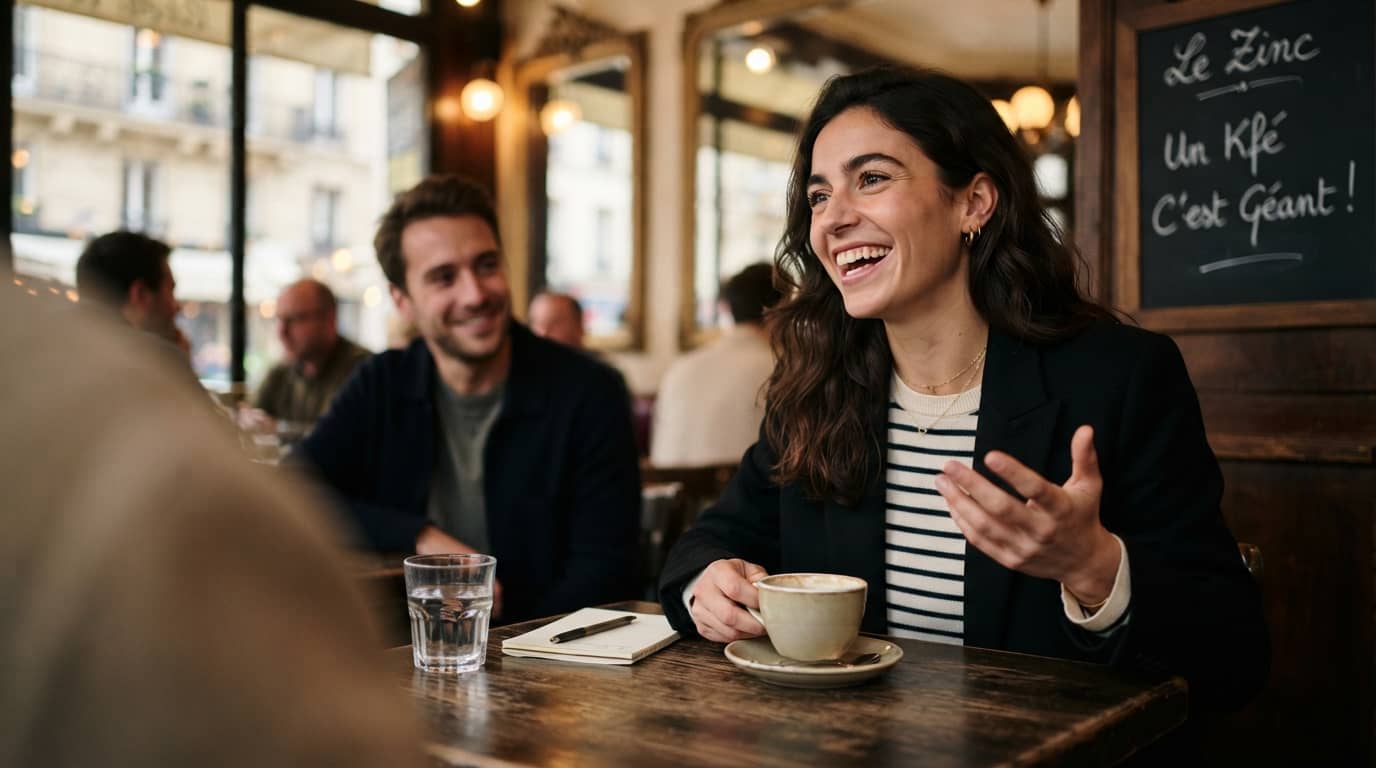
You’ve spent months learning French. You can conjugate verbs, order a coffee, ask for directions. Then you land in Paris, and someone tells you they’re going to “bosser” before they “bouffent un truc“, and you’re completely lost. Welcome to the gap between textbook French and how Parisians actually talk. Here’s the slang that’ll help you blend in instead of standing out like a lost tourist clutching a map.
Why textbook French won’t save you in Paris
Classroom French teaches you the correct, polished version of the language. It’s essential, you need that foundation. But it won’t prepare you for a real conversation in a Paris café or on the metro, where locals speak fast, drop words, and lean heavily on argot (slang).
The truth is, Parisians don’t talk like a grammar exercise. They shorten words, swap in slang terms, and use expressions you’ll never find in your school book. Knowing a bit of everyday vocabulary makes you sound natural, and it shows locals you’ve made the effort to understand their Paris, not just the tourist version.
The everyday words you’ll hear constantly
Some slang words are so common that Parisians use them without even thinking. If you only learn a handful of expressions, make it these, they’ll come up in almost every casual conversation.
- Bosser, to work (instead of travailler)
- Bouffer, to eat (a very casual version of manger)
- Un truc, a thing / a whatchamacallit
- Kiffer, to like or love something (je kiffe ce resto = I love this restaurant)
- Un mec / une meuf, a guy / a girl
- Le boulot, work or the workplace (je vais au boulot)
Drop one of these naturally into a conversation and watch how the tone shifts. Suddenly you’re not the tourist asking questions, you’re someone who actually gets how people talk here.
Verlan: the slang that flips words around
If there’s one thing that confuses foreigners more than anything, it’s verlan. This is a form of slang where syllables are reversed. The word “verlan” itself comes from l’envers (backwards), flipped around. It sounds like a puzzle, but once you spot the pattern, you’ll start recognizing it everywhere.
A few classics: meuf comes from femme (woman), relou from lourd (annoying/heavy), and ouf from fou (crazy). When a Parisian says something was “un truc de ouf,” they mean it was insane, in a good way. You don’t need to speak verlan fluently, but understanding it will stop you from freezing up when a conversation takes an unexpected turn.
Words to sound relaxed, not stiff
Formal French can make you sound like you’re reading from a manual. A few casual expressions instantly loosen up your speech and make you seem more at ease, which is exactly how Parisians talk among friends.
Instead of saying oui all the time, you’ll hear ouais (yeah). Money isn’t argent, it’s du fric or du pognon. A car is une caisse, a phone is un tel (short for téléphone), and when something is expensive, Parisians say it “coûte un bras“, it costs an arm. And that friend you’re meeting? They’re not your ami, they’re your pote.
The key is not to overdo it. Sprinkle these in naturally. Nobody trusts a foreigner who suddenly speaks nothing but slang, it sounds forced. A word or two at the right moment is all it takes.
Expressions that reveal you know the city
Beyond individual words, Parisians rely on set phrases that carry a lot of meaning. These are the expressions that separate someone who studied French from someone who’s actually lived the language.
“J’en peux plus” means I can’t take it anymore, perfect for a long metro ride. “C’est chaud” literally means “it’s hot,” but really means something is difficult or intense. “Laisse tomber” means forget it, drop it. And “Ça marche“, literally “it walks”, is how Parisians say “sounds good” or “that works.” You’ll hear that last one dozens of times a day.
How to actually pick up Parisian slang
You can memorize word lists all day, but slang only sticks when you hear it in context and use it out loud. That’s why immersion beats any app. Listening to how people speak on the terrace, in shops, on the street, that’s where the real learning happens.
At ACCORD French Language School, right in the heart of Paris near the Eiffel Tower, you learn French the way it’s actually spoken. Our intensive and semi-intensive courses combine solid grammar with the everyday language you’ll use the moment you step outside. Whether you’re here for a few weeks or preparing for an official exam like the TCF, you’ll leave sounding less like a tourist and more like someone who belongs. And that, honestly, is the whole point of learning a language in the first place.
