
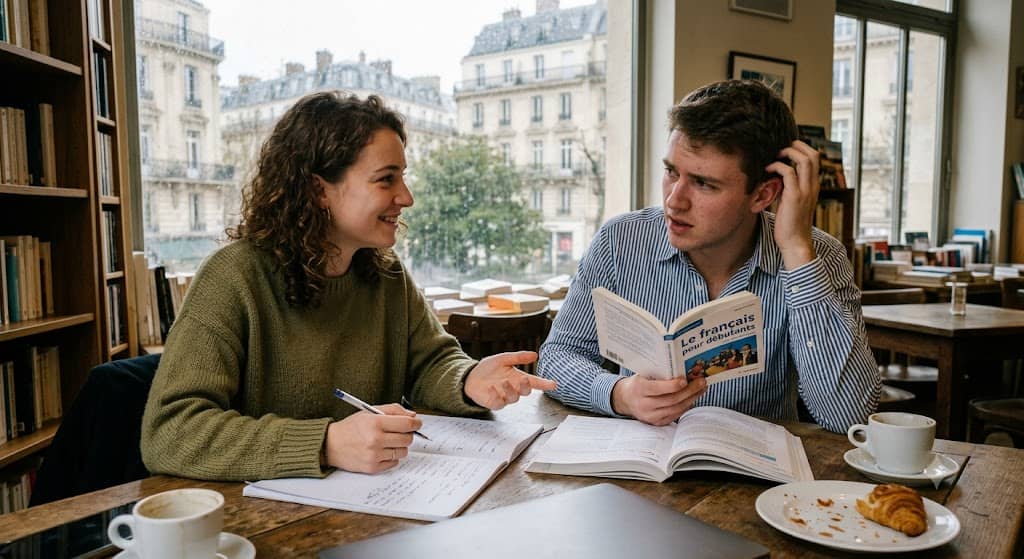
You’ve decided to learn French, and now everyone’s telling you it’s a nightmare of silent letters, tricky pronunciation, and grammar rules that make no sense. Before you panic, let’s set the record straight. French is actually one of the easiest languages for an English speaker to learn, and the reasons might surprise you.
Yes, there are challenges, but none of them are dealbreakers. Here’s an honest look at what makes French accessible, what genuinely trips people up, and how to get through it.
English and French share thousands of words
Here’s something most people don’t realize: English borrowed heavily from French. After the Norman conquest of 1066, French became the language of the English court for centuries. The result? About 30% of English vocabulary comes directly from French.
Words like table, restaurant, important, nation, possible, and animal are spelled almost identically and mean the same thing in both languages. These are called cognates, and they give you a real head start. When you open a French text for the first time, you’ll already recognize hundreds of words without studying them. Compare that to Mandarin or Arabic, where you start from zero, and you’ll see what a shortcut this is.
The grammar has real differences
The grammar is where most English speakers hit a wall, and a few specific points come up again and again:
- Gendered nouns: every noun is either masculine or feminine, and there’s often no logic to it. Why is la table feminine but le bureau masculine? You just have to learn them.
- Verb conjugations: French verbs change form depending on the subject and tense, far more than English verbs do.
- Agreement rules: adjectives have to match the gender and number of the noun they describe.
None of this is impossible, but it does take consistent practice. The good news is that French grammar is pretty regular once you understand the patterns. Unlike English, where pronunciation and spelling rules break constantly, French follows its own logic reliably. Learn how one verb group works, and you can apply it across hundreds of verbs.
Pronunciation takes some getting used to
This is probably the part that intimidates people the most. French has sounds that simply don’t exist in English: the nasal vowels in words like pain or bon, the famous French “r” that comes from the back of the throat, and the u in tu that English speakers tend to mangle at first.
Then there’s the gap between spelling and sound, which feels chaotic at the start. Words are full of letters you don’t pronounce, and liaison (linking the end of one word to the start of the next) makes spoken French sound like one continuous stream. But here’s the reassuring part: French pronunciation is consistent. Once you learn the rules, you can read almost any word correctly. English, with its though, through, tough, and thought, is arguably far more unpredictable.
Where French is genuinely easier than you’d expect
People focus so much on the hard parts that they forget what’s straightforward. French sentence structure is very close to English: subject, verb, object, in that order. You won’t have to rewire your brain the way you would with German or Japanese word order.
The alphabet is the same, so there’s no new writing system to memorize. You can start reading right away. And because French shows up everywhere in films, music, food, and fashion, you’ll never run short of free material to practice with. Immersion is easy to come by, especially if you study in France, where the language surrounds you all day.
How long does it actually take?
The U.S. Foreign Service Institute classifies French as a Category I language, among the easiest for English speakers. They estimate around 600 to 750 hours of study to reach professional working proficiency. That puts it in the same bracket as Spanish and Italian, and well ahead of Russian, Arabic, or Korean, which can take three to four times longer.
The timeline depends entirely on how you learn, though. An hour a week with a textbook will get you nowhere fast. Intensive, structured lessons combined with daily exposure move you forward much quicker. This is exactly why studying in Paris works so well: you practice in real situations, not just in a classroom.
What makes the difference when you learn
The difficulty of French has less to do with the language itself and more to do with how you approach it. Trying to learn alone, without correction or conversation practice, makes everything harder than it needs to be. A teacher who catches your mistakes, explains the logic, and gives you the confidence to speak changes the whole experience.
At ACCORD French Language School, near the Eiffel Tower in Paris, we’ve been teaching French to students from around the world since 1988. Whether you want an intensive course, exam prep for the TCF, or Business French, the goal is the same: get you speaking, understanding, and feeling at ease as quickly as possible. French isn’t difficult. It just needs the right method and a bit of immersion. And learning it in the city where the language actually lives makes the whole thing a lot more enjoyable.
