
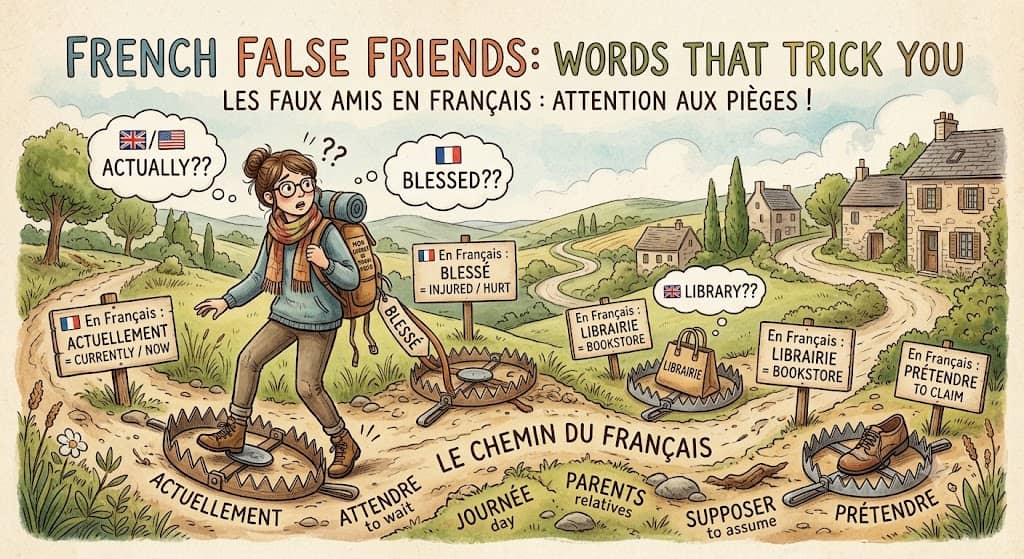
You’ve been learning French for months. You feel confident. Then you tell someone you’re excité about your trip to Paris, and they look at you strangely. What happened? You just walked straight into the false friends trap. These words look familiar, sound like English, but mean something completely different. They’re everywhere in French, and even advanced learners get caught. Here’s how to spot them before they sabotage your next conversation.
What exactly is a false friend?
A false friend (or faux ami in French) is a word that looks or sounds almost identical in two languages but means something different. French and English share thousands of words thanks to their tangled history, which is great news when you’re building vocabulary. The problem is that some of these shared words drifted apart over the centuries.
Take librairie. It looks like “library,” so you’d expect a place full of books you can borrow. Wrong. A librairie is a bookshop, where you buy books. The actual library is a bibliothèque.
One small mix-up, and you’re asking to borrow a book in a shop where everything’s for sale!
The classics that catch everyone
Some false friends are so common that nearly every English speaker trips over them at least once. They feel natural precisely because they’re so close to English, and that’s what makes them dangerous. You don’t stop to question them.
A few worth memorising right away:
- Actuellement doesn’t mean “actually.” It means currently or “at the moment.” For “actually,” use en fait.
- Attendre isn’t “to attend.” It means to wait. To attend an event, you assister à.
- Sensible means sensitive, not “sensible.” Telling someone they’re sensible is a compliment about their feelings, not their judgement.
- Rester means to stay, not “to rest.” If you’re tired and want to rest, you need se reposer.
When a false friend gets embarrassing
Some mistakes are harmless. Others make a room go quiet. The word excité is a perfect example. In English, “excited” is positive and innocent. In French, excité has a sexual connotation. So when you say je suis excité about visiting the Louvre, you’re saying something you definitely didn’t mean. To express enthusiasm, go with je suis content or j’ai hâte.
Another classic landmine is préservatif. It looks like “preservative,” the kind you’d find in processed food. But a préservatif is a condom. Read a French food label and ask about the préservatifs, and you’ll get some very surprised looks. The word for a food preservative is conservateur.
Why French is full of them
This isn’t a coincidence. After the Norman conquest in 1066, French poured into English on a massive scale. Both languages then borrowed from Latin independently over the following centuries. The result is a huge overlap of vocabulary where meanings drifted apart on each side of the Channel.
That’s why words like demander (to ask, not “demand”), passer un examen (to take an exam, not “pass it”), or blesser (to wound, not “bless”) feel so deceptive. The roots really are shared. The meanings just went their separate ways. Knowing this history won’t make the words easier to remember, but it explains why French has so many traps compared to a language with no connection to English at all.
How to stop falling for them
You can memorise a list, but false friends only really stick once you’ve used a word wrong in conversation and felt that awkward pause. Those moments teach you faster than any flashcard.
The trick is to stay suspicious when a word seems too easy. If a French word looks exactly like English, that’s your cue to double-check rather than assume.
Reading in French helps a lot here. When you see éventuellement used in context, you realise it means possibly, not “eventually” (which would be finalement). Context does the heavy lifting that translation alone can’t. This is also where structured lessons earn their keep, because a teacher catches your false friends in real time and corrects them before they harden into habits.
Learning French where it actually clicks
You can study false friends from a textbook anywhere in the world, but nothing beats hearing how French people actually use these words.
At ACCORD French Language School in central Paris, our courses put you in real conversations where these tricky words come up on their own. From intensive French courses to DELF exam preparation, you learn the language the way it’s genuinely spoken, mistakes corrected and all.
Whether you’re a beginner still confusing librairie and bibliothèque, or an advanced student polishing your fluency before a TCF exam, immersion in Paris gives you the daily practice that turns false friends into words you’ll never mix up again. Once you’ve ordered a coffee, asked for directions, and chatted with locals, those tricky words stop being traps and start feeling like second nature.
