
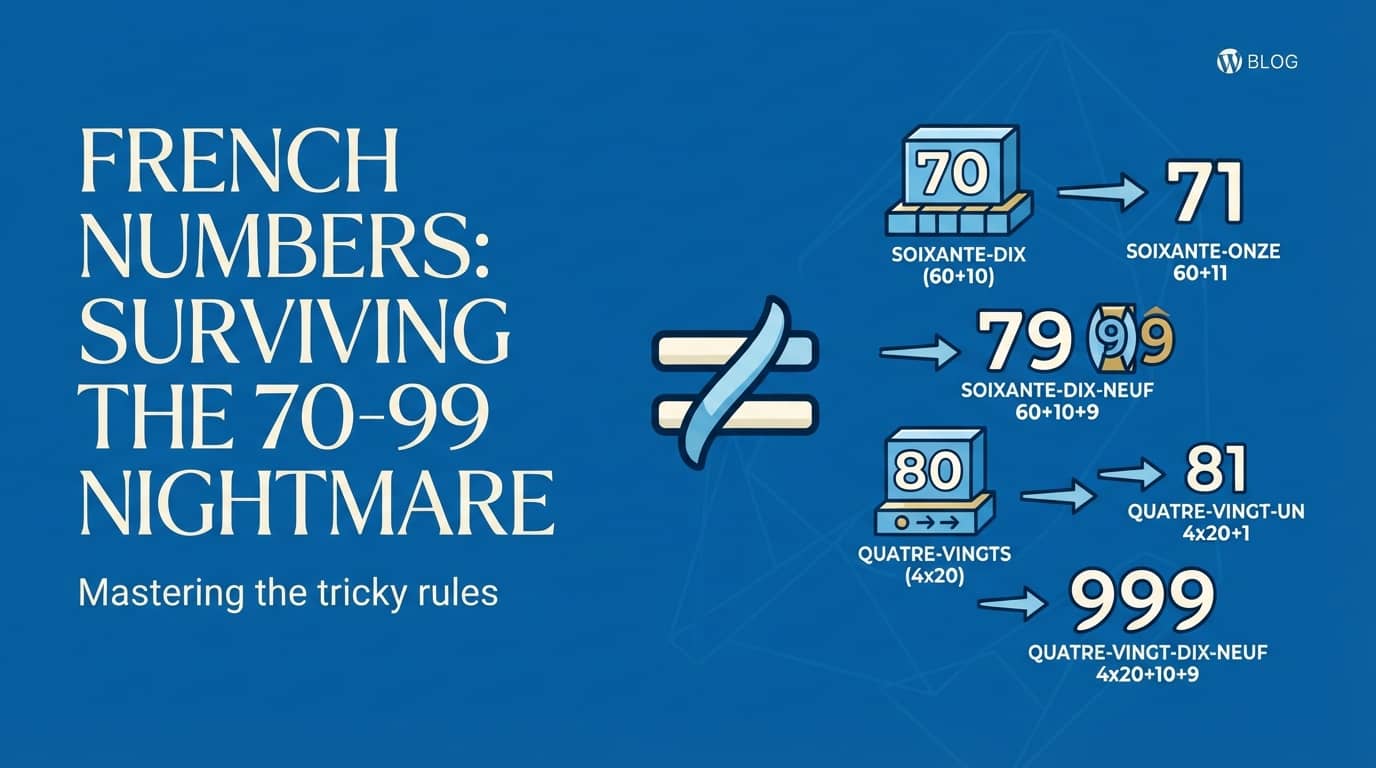
You’ve learned to count to sixty in French, you feel confident, and then… soixante-dix. Wait, that literally means “sixty-ten”? And it only gets worse from there! If French numbers between 70 and 99 have ever made you freeze mid-sentence, you’re not alone. This part of the language trips up nearly every learner, and there’s a logical (if slightly odd) reason behind it. Let’s break it down so you can finally handle prices, phone numbers and dates without panicking.
Why do French numbers get weird after 69?
Up to soixante-neuf (69), everything follows a clean pattern: dix, vingt, trente, quarante, cinquante, soixante. Each tens unit has its own word. Then France decided to stop inventing new words and started doing math instead.
The reason is historical. French counting kept traces of an old base-20 system (called the vigesimal system), inherited partly from Celtic influence. Instead of creating fresh words for 70, 80 and 90, the language builds them by combining smaller numbers.
So you end up literally adding and multiplying out loud every time you say a number in this range. It feels strange at first, but once you see the logic, it stops being random.
The 70s: sixty plus ten
Here’s where the mental gymnastics start. Seventy is “soixante-dix”, literally “sixty-ten.” From there, you keep adding:
- 71 = soixante et onze (sixty and eleven)
- 72 = soixante-douze (sixty-twelve)
- 75 = soixante-quinze (sixty-fifteen)
- 79 = soixante-dix-neuf (sixty-nineteen)
Notice that 71 keeps the little “et” (and), just like 21, 31, 41, 51 and 61 do. But from 72 onwards, the “et” disappears. This is one of those small details that native speakers do without thinking, and learners tend to overcorrect. Say it out loud a few times and the rhythm sticks faster than you’d expect.
The 80s: four times twenty
If the 70s surprised you, the 80s are where the base-20 logic becomes obvious. Eighty is “quatre-vingts”, literally “four twenties” (4 × 20 = 80). Yes, you’re multiplying now.
Then you add units on top:
- 81 = quatre-vingt-un (four-twenty-one)
- 85 = quatre-vingt-cinq
- 89 = quatre-vingt-neuf
One spelling trap worth knowing: quatre-vingts takes an “s” when it’s exactly 80, but loses it as soon as another number follows (quatre-vingt-un, quatre-vingt-deux…). Also, there’s no “et” in eighty-one, it’s just quatre-vingt-un, not “quatre-vingt et un.” Small rule, easy to remember once it clicks.
The 90s: four twenties plus a teenager
By now you can probably guess where this is going. Ninety is “quatre-vingt-dix”, “four-twenty-ten” (80 + 10). To reach the higher nineties, you keep stacking teens onto quatre-vingt:
- 91 = quatre-vingt-onze (four-twenty-eleven)
- 95 = quatre-vingt-quinze
- 99 = quatre-vingt-dix-neuf (four-twenty-nineteen)
So 99 literally translates to “four twenties nineteen.” It looks intimidating written out, but in real conversation it flows quickly. The key is treating “quatre-vingt” as a single block and then adding the teen number after it, exactly like you did in the 70s.
What about Belgium, Switzerland and Quebec?
Here’s some good news that might make you feel better about the whole thing: not all French speakers use this system. In parts of Belgium and Switzerland, people use the far more logical septante (70), and in Switzerland huitante or octante (80) and nonante (90) in some regions. Belgium keeps quatre-vingts for 80 but uses nonante for 90.
So when someone says French counting is illogical, they’re mostly talking about the version used in France. If you ever travel to Geneva or Brussels, you’ll hear cleaner numbers and probably wonder why France made life harder for everyone. That said, if you’re learning standard French for exams like the TCF, you’ll need the soixante-dix / quatre-vingts system, so it’s worth mastering with French courses for adults in Paris.
How to actually get comfortable with these numbers
Reading the rules is one thing. Using them under pressure, when a cashier tells you a price or someone gives you their phone number, is another. The trick is exposure and repetition in context, not just memorizing tables.
Practise with real-life situations: listen to prices at the market, read phone numbers aloud (French people say them in pairs, like “quatre-vingt-douze” for 92), and count backwards from 100 to force your brain out of autopilot. Speaking the numbers out loud matters far more than reading them silently, because the whole challenge is processing them fast enough to keep up with a conversation. This is exactly the kind of everyday fluency you build in an immersive course in Paris, where you’re surrounded by these numbers all day, in shops, on the metro, in class, until soixante-dix and quatre-vingt-dix-neuf stop feeling like puzzles and start feeling automatic.
