
History & Meaning: Why Is the French Flag Blue, White, and Red?
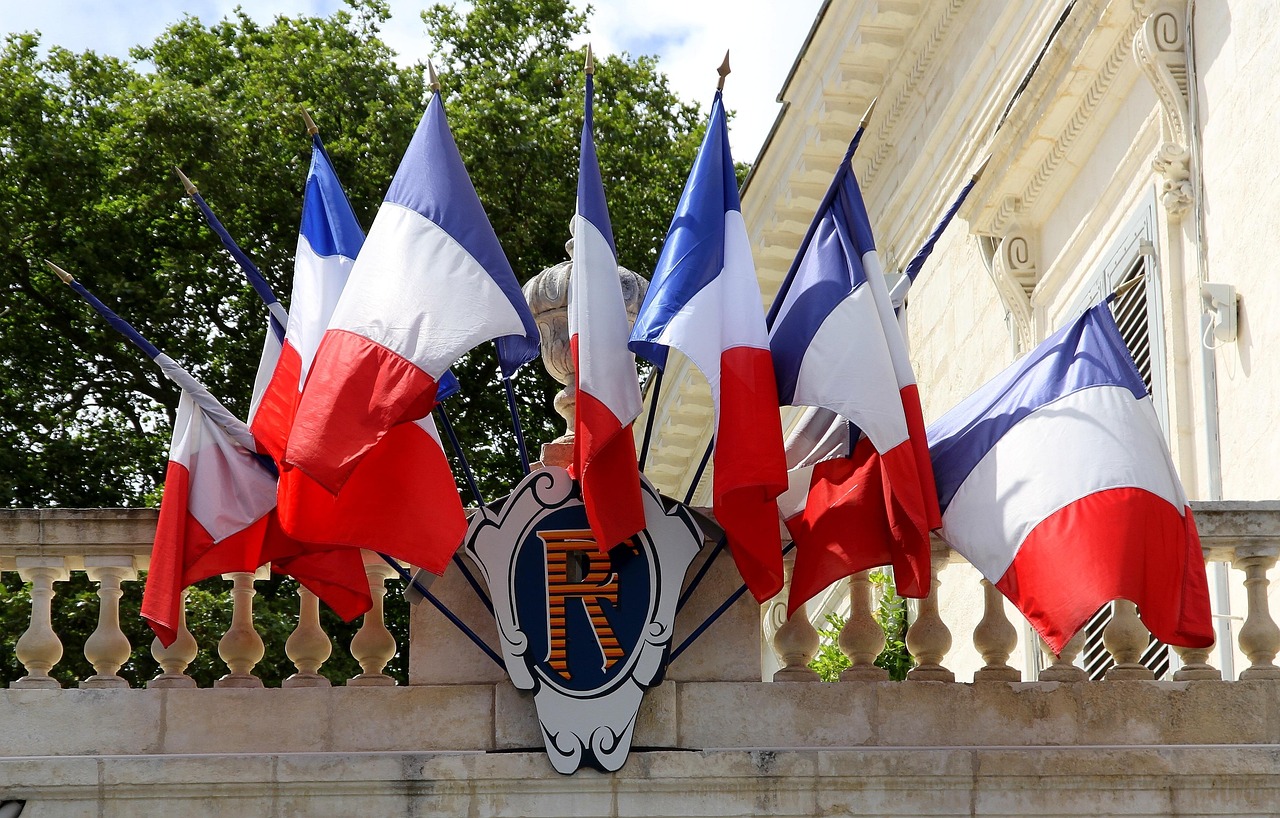
Stroll through any French town on July 14th and you will see it everywhere fluttering from windows, atop town halls, and on café terraces, just as you will all year round on the facades of all town halls and official buildings: the French tricolour flag. Blue, white, and red, three simple vertical bands that instantly say “France” to anyone in the world. But why these three colours, and why in this order?
Behind France’s national flag lies a story of kings, revolutionaries, and centuries of political change. It’s the kind of cultural detail that makes so much more sense once you’re living and learning French in France.
The Meaning of Blue, White, and Red
Each colour of the French flag carries its own symbolism, shaped by history.
- Blue has long been associated with Paris and, further back, with Saint Martin, a soldier who became the patron saint of the French army. Over time, blue came to represent freedom and the French people standing against tyranny.
- White was historically the colour of the French monarchy and the House of Bourbon. Rather than disappearing after the Revolution, white was kept at the centre of the new flag, symbolising unity, and, in the context of the new Republic, purity.
- Red, alongside blue, was one of the traditional colours of the city of Paris. During and after the Revolution, red came to represent courage and the sacrifices made in the fight for liberty.
Together, the three colours are widely understood today as embodying the revolutionary motto that still defines France: liberté, égalité, fraternité (liberty, equality, fraternity).
The History of the French Flag
Before the Tricolore existed, France had no single national flag. Under the monarchy, the country was represented by a variety of banners, most famously a blue shield decorated with three golden fleurs-de-lys, later displayed against a white background, the colour of the Bourbon dynasty.
Everything changed with the French Revolution of 1789. After the storming of the Bastille, the Marquis de La Fayette presented a blue-and-red cockade, the traditional colours of Paris, to King Louis XVI. White, the colour of the monarchy, was added to the cockade to symbolise the (short-lived) alliance between the king and the French people. This tricolour cockade quickly became a badge of loyalty worn by revolutionaries across the country.
The cockade’s colours soon made their way onto flags. In 1790, a flag with three vertical stripes was adopted for French ships. It wasn’t until 1794, however, that the National Convention formally fixed the design we recognise today: blue nearest the flagpole, white in the centre, and red flying free at the edge.
The flag’s story didn’t end there. When the monarchy was restored between 1814 and 1830, the Tricolore was set aside in favour of the plain white royal flag. It made its comeback after the July Revolution of 1830 and has remained France’s national emblem ever since, officially enshrined in both the 1946 and 1958 constitutions, and confirmed today in Article 2 of the French Constitution.
Do Other Countries Use the Same Three Colours?
France was far from the only country to adopt a blue, white, and red flag. In fact, the design has inspired dozens of nations across the world. A few notable examples:
- The Netherlands: often credited with one of the earliest tricolour flags, dating back to the 16th century, though arranged in horizontal red-white-blue stripes rather than France’s vertical bands.
- Luxembourg: a horizontal red-white-light blue tricolour, visually close to the Dutch flag but with its own distinct shades and origins tied to the coat of arms of the House of Luxembourg.
- Russia: a horizontal white-blue-red flag, historically linked to the influence of Western European maritime flags.
- The United Kingdom: the Union Jack combines the same three colours in a very different cross-based design.
- The United States: the Stars and Stripes, another revolutionary-era flag built on red, white, and blue.
- Many former French colonies and territories, including Quebec and Martinique, which still carry echoes of historic French blue-and-white designs.
Altogether, more than 30 countries around the world fly flags built from this same trio of colours, making blue, white and red one of the most popular colour combinations in flag design, closely tied to ideas of liberty, revolution, and independence.
Fun Facts About the French Flag
- The Tricolore‘s exact colour order was reportedly finalised with input from the painter Jacques-Louis David.
- The flag’s official name, le drapeau tricolore, simply means “the three-coloured flag”.
- Despite popular belief, the Gallic rooster is not an official symbol of France, the tricolour flag and La Marseillaise, the national anthem, hold that status.
- France’s flag ratio is 2:3, the same proportions used by many other national flags around the world, including the Netherlands and Russia.
Discover French Culture and History In Paris
Learning French language is never just about grammar and vocabulary, it’s about understanding the culture, history, and symbols that shape everyday life. Knowing why the French flag is blue, white, and red is an example of the kind of cultural insight that makes learning French so much richer when you do it in France itself.
At ACCORD French Language School in Paris, our French language courses combine language learning with real immersion in French culture and history, just steps from some of the city’s most iconic landmarks. Our students don’t just memorise facts about France, they walk past the Tricolore flying over public buildings every day, discuss French history with their teachers, and start to understand the country from the inside out.
So, if a flag’s story can spark this much curiosity, imagine what a few weeks of full immersion in Paris could teach you. Join ACCORD Paris and turn your curiosity about French culture into real, spoken French.
