
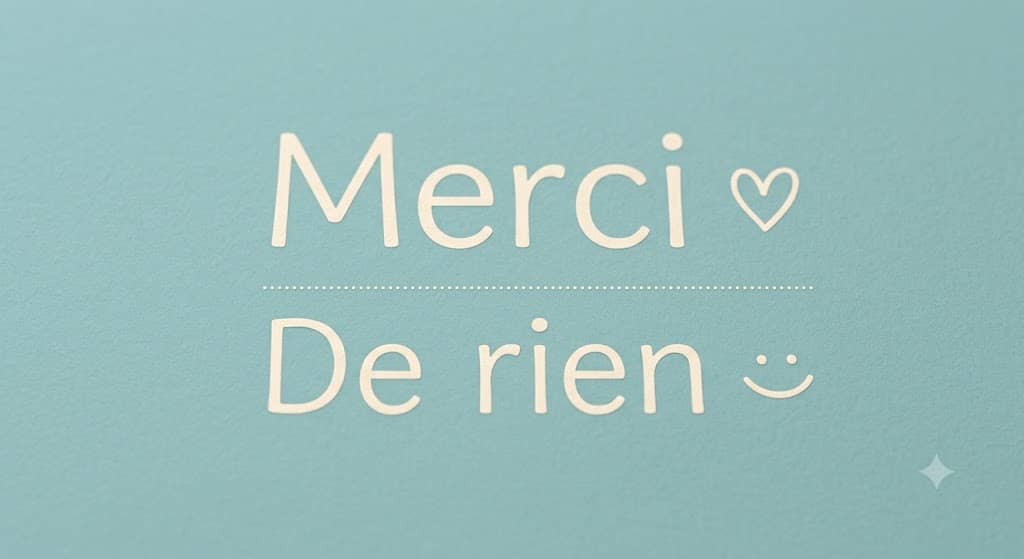
In French, saying “thank you” and “you’re welcome” isn’t as simple as memorizing two words. Politeness in France comes with layers: formal or casual, warm or distant, spoken or written. Get it wrong and you might sound too stiff with friends or too relaxed with a stranger. Here’s how to navigate the subtleties of French gratitude so you sound natural, not like a phrasebook.
Merci, but how much?
The base word is merci. Easy enough. But the French rarely leave it there. To soften it or make it warmer, you’ll often hear merci beaucoup (thank you very much) or the more emphatic merci infiniment (thanks a million, literally “infinitely”).
When you want to thank someone for something specific, use merci pour with a noun, or merci de with a verb. So it’s merci pour le café (thanks for the coffee), but merci de m’avoir aidé (thanks for helping me). This distinction trips up a lot of learners, and getting it right makes you sound noticeably more fluent.
The polite ways to say you’re welcome
Here’s where things get interesting. There’s no single translation for “you’re welcome” in French. The right choice depends on the situation, the relationship, and even the region. The most common replies you’ll hear:
- De rien : “It’s nothing.” Casual, friendly, used everywhere.
- Je vous en prie / Je t’en prie : Polite and slightly formal. The vous version is what you’d use with a stranger or in a professional setting.
- Avec plaisir : “With pleasure.” Warm and genuine, increasingly popular.
- Pas de souci : “No worries.” Very casual, common among younger people.
- Il n’y a pas de quoi : “There’s no reason to thank me.” A bit old-fashioned but still heard.
Each one carries a different temperature. De rien works in almost any everyday situation, while je vous en prie is your safe bet when you want to show respect.
When formality really matters
The big divide in French politeness is tu versus vous, and it affects everything, including how you respond to thanks. With a colleague’s boss, a shopkeeper, or anyone older you don’t know well, stick with je vous en prie. It’s elegant and signals respect without being cold.
In a professional email, the rules tighten further. You’ll often close with something like Je vous remercie de votre attention (Thank you for your attention) followed by a formal sign-off. Dropping a casual de rien in a business message would feel out of place, almost careless. Context dictates tone here, and the French are quite sensitive to it.
Regional and generational habits
Language lives, and the way people say you’re welcome shifts depending on where you are and who you’re talking to. In Quebec, for instance, you’ll commonly hear bienvenue as a response to merci, a direct calque from English that would sound odd in Paris.
There’s a generational split too. Pas de souci has spread fast among younger French speakers, sometimes to the irritation of older generations who find it sloppy. Meanwhile, avec plaisir has become a favorite in cafés and shops, especially in the service industry, where it adds a touch of warmth. Listening to how locals actually speak teaches you more than any rulebook.
Common mistakes foreign learners make
The most frequent slip is treating bienvenue as “you’re welcome” in France. It almost always means “welcome” (as in welcoming someone to a place), not a reply to thanks. Another classic error is overusing merci in writing without varying the structure, which quickly sounds robotic.
Learners also tend to forget that responding to thanks is expected. Staying silent after someone says merci can come across as rude. A quick de rien or je vous en prie keeps the social exchange flowing. These small reflexes are exactly what you pick up through immersion, when you actually live the language rather than study it on paper.
Practicing the real thing in Paris
Reading about these nuances is one thing; using them without hesitation is another. The fastest way to internalize when to say avec plaisir versus je vous en prie is to be surrounded by French speakers every day. That’s where structured lessons combined with real-life immersion make the difference.
At ACCORD French Language School, located in central Paris near the Eiffel Tower, students from all over the world build exactly this kind of practical fluency. Whether you choose an intensive French course, a semi-intensive program, or an exam preparation for the DELF, you’ll practice politeness and conversation in real contexts, not just textbook exercises. Open year-round and welcoming students from age 16, the school turns these everyday subtleties into second nature.
