
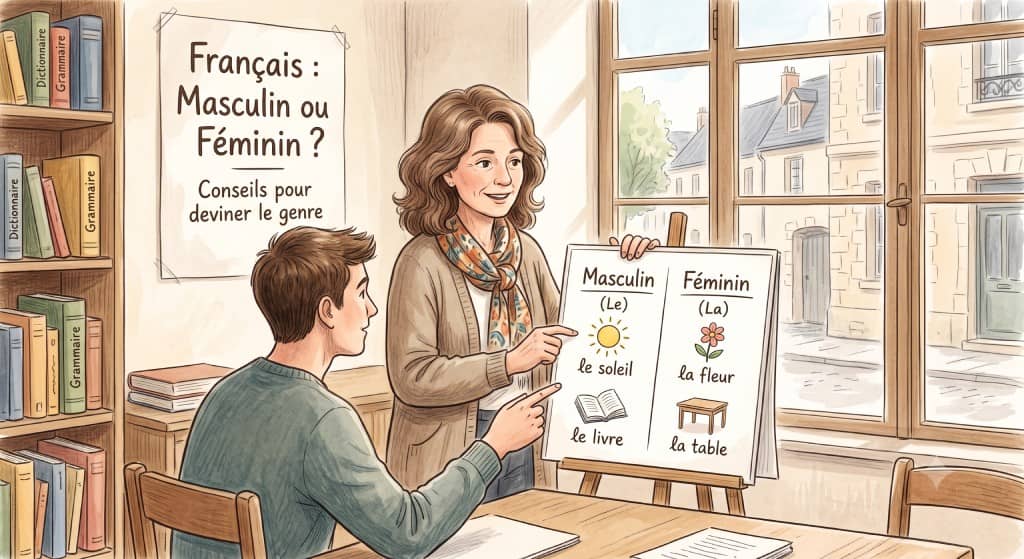
If there’s one thing that drives French learners crazy, it’s grammatical gender. Why is le soleil (the sun) masculine and la lune (the moon) feminine? There’s rarely a logical reason. But here’s the good news: French follows certain patterns that can help you guess the gender of a word more often than not. You won’t be right every time, but these tips will save you a lot of guesswork.
Why gender matters so much in French
In English, gender barely exists. In French, it’s everywhere. Every noun is either masculine or feminine, and that choice affects the articles (le/la, un/une), the adjectives, and sometimes the verb forms in the past tense.
Getting the gender wrong won’t make you incomprehensible, but it sounds off to native speakers, the same way “a apple” sounds strange in English. And because articles and adjectives have to agree, one small slip quickly spreads across the whole sentence.
Trust the word endings
The most reliable trick is to look at the ending of the word. French has plenty of suffixes that point toward one gender or the other. They’re not foolproof, but they’re right most of the time.
Some endings are usually feminine: -tion, -sion, -té, -ette, -ence, -ance, -ie, -ure. Think of la nation, la liberté, la maquette, la culture.
On the masculine side, you’ll often find -age, -ment, -eau, -isme, -eur (for non-human nouns), and -ier. For example: le fromage, le gouvernement, le bureau, le tourisme.
- Likely feminine endings: -tion, -té, -ence, -ette, -ure, -ie
- Likely masculine endings: -age, -ment, -eau, -isme, -ier
Watch out for the classic exceptions
Of course, French wouldn’t be French without exceptions. Some words break the rules, and they tend to be common ones you’ll use every day, so they’re worth memorizing on their own.
A few famous traps: le musée and le lycée are masculine even though they end in -ée, normally a feminine ending. La page, la plage, l’image, and l’eau go against the masculine -age and -eau patterns.
And le silence is masculine despite ending in -ence. The lesson is simple: use the endings as a guide, not as a law. When you spot an exception, pay it extra attention so it sticks.
Categories that follow logical rules
Beyond endings, certain groups of words behave predictably. Languages, for instance, are always masculine: le français, l’anglais, l’espagnol. The same goes for days, months, seasons, metals, and colors used as nouns: le lundi, le printemps, l’or, le bleu.
On the feminine side, most academic disciplines ending in -ie follow the rule: la biologie, la géographie, la philosophie. Many countries ending in -e are feminine too (la France, l’Italie, l’Espagne), with a few exceptions like le Mexique. Learning these as blocks is far more efficient than tackling words one by one.
People and animals: meaning over rules
When a noun refers to a person, the gender usually matches the real-life gender. Un homme is masculine, une femme is feminine, un acteur becomes une actrice. That makes a whole chunk of vocabulary much more intuitive.
Animals can be trickier. Some have one fixed gender no matter the actual animal: une souris (a mouse) is always feminine, un serpent (a snake) is always masculine, whether the creature is male or female.
For these, just learn the word with its article and move on. It’s the safest habit you can build.
The best habit: learn the article with the noun
Here’s the advice every experienced teacher gives, and it works: never memorize a noun on its own. Always learn it with its article. Don’t store “table” in your memory, store “la table”. Don’t learn “livre”, learn le livre.
This way, the gender becomes part of the word itself, and you stop having to “calculate” it every time you speak. Over time, your brain builds an instinct, and you’ll start feeling when something sounds masculine or feminine, even without knowing why. At ACCORD French Language School in Paris, our teachers reinforce this reflex from your very first lessons, mixing grammar tips with plenty of speaking practice so the rules become second nature.
With enough exposure and the right method, guessing the gender stops being a chore and starts being automatic.
