
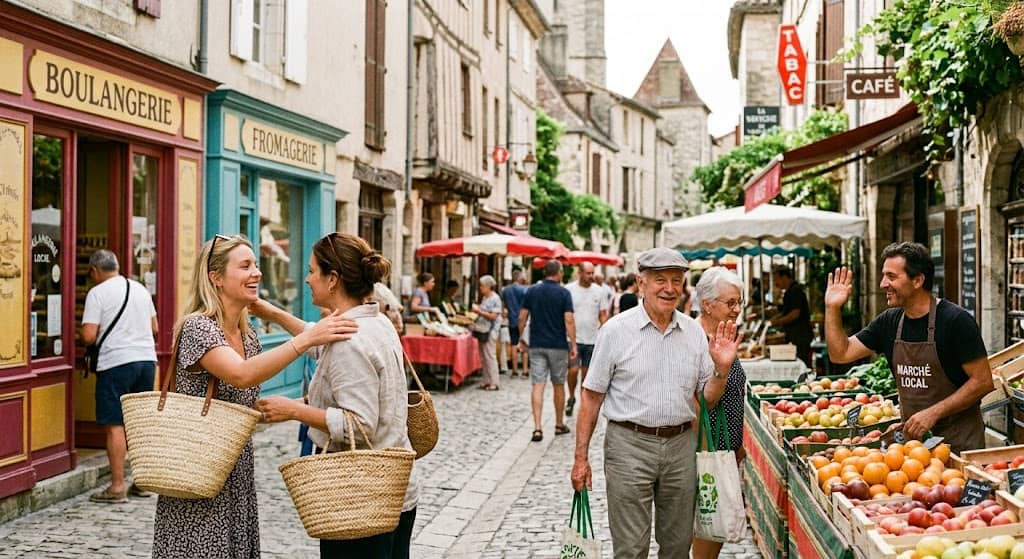
You learned “bonjour” and “au revoir” in your first French lesson. Good start. But the moment you step into a Parisian café or chat with a colleague, you’ll notice the French juggle a whole range of greetings depending on the time, the person, and the mood. Knowing when to use each one matters just as much as knowing the words. Here are 10 ways to greet people and say goodbye in French, so you sound natural instead of like a textbook.
Bonjour, the one you can’t skip
Bonjour is your safe bet in almost any situation. You say it to the baker, the bus driver, your boss, or a stranger in an elevator. In France, walking into a shop without saying bonjour first comes across as rude, so make it a reflex.
It literally means “good day” and works from morning until late afternoon. After that, switch to bonsoir (good evening). There’s no hard rule about the exact hour, but once the sun starts setting, bonsoir takes over. Get these two right and you’ll already blend in better than most beginners.
Salut, for friends and casual moments
Salut is the friendly, informal cousin of bonjour. You’ll hear it constantly among friends, classmates, and younger people. The handy thing? It works both ways: salut means hello and goodbye depending on the context.
Just don’t use it with someone you’ve just met in a professional setting, or with an older person you don’t know well. Stick to bonjour there. Salut is for people you’re comfortable with, the same way you’d say “hey” in English rather than “good morning.”
Coucou, the affectionate one
Coucou is very casual, almost playful. It’s what you say to close friends, family, or your partner, often with a smile. You’ll see it a lot in text messages too.
Saying coucou to your bank manager would feel strange, even funny. Keep it for the people you genuinely like. It carries a warmth that salut doesn’t always have, and picking up on these differences is what helps you sound like a local rather than a tourist reading from a phrasebook.
Greetings that depend on time and people
French greetings shift depending on who’s in front of you and what time it is. Here’s a quick overview:
- Bonjour : universal, daytime, formal or casual
- Bonsoir : evening, all situations
- Salut : informal, friends and peers
- Coucou : very informal, close circle
- Allô : only on the phone, never in person
That last one trips up a lot of learners. Allô is only for answering the phone. Saying it to greet someone face to face would sound completely off. Small details like these are easy to miss on your own, which is why practicing with native speakers makes such a difference.
Au revoir and its everyday alternatives
Au revoir is your standard goodbye, polite and appropriate everywhere. It literally means “until we see each other again.” Like bonjour, you can’t really go wrong with it.
But the French rarely stop there. À bientôt (see you soon), à plus tard (see you later, often shortened to à plus in speech), and à demain (see you tomorrow) all add a little precision. If you’re leaving a friend you’ll see the next day, à demain sounds far more natural than a flat au revoir.
Bonne journée and the art of well-wishing
Here’s something the French do constantly that beginners often forget: they wish you a good rest of your day when you leave. Bonne journée (have a good day) and bonne soirée (have a good evening) come right after the goodbye.
So a complete, natural exit sounds like: “Au revoir, bonne journée !” Shopkeepers say it to customers, neighbours say it to each other, and you should too. There’s also bonne nuit (good night), but careful: it’s only used when someone is actually going to sleep, not just leaving for the evening.
À tout à l’heure and the “à” family
The little word “à” opens up a whole set of friendly goodbyes that signal when you’ll meet again. À tout à l’heure means “see you later today,” while à tout de suite means “see you in a moment,” when you’re literally about to come right back.
In everyday speech, you’ll hear French people shorten these to à tout’ or à plus’. These casual versions are everywhere among friends, and using them shows you’ve moved past the basics. The fastest way to pick all this up is to spend time surrounded by people who use these expressions every day, which is exactly what learning French in Paris with us is built for.
