
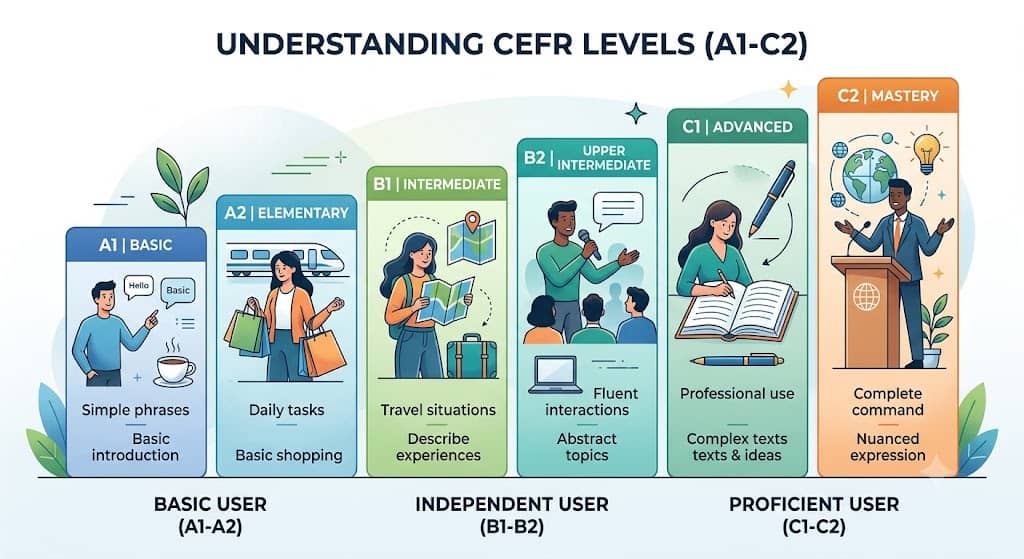
You’ve started learning French and someone asks if you’re “B1” or “A2”. You nod politely, but you have no idea what those letters mean. Don’t worry, you’re not alone. The CEFR (Common European Framework of Reference for Languages) is the standard scale used across Europe to measure language ability, from absolute beginner to near-native. Here’s what each level actually means, and how to figure out where you stand.
What is the CEFR and why does it matter?
The CEFR was developed by the Council of Europe to create one shared way of describing language skills. Before it existed, every country and every school had its own grading system, which made comparing levels a nightmare. A “good” level in one place meant nothing somewhere else.
Today it’s used everywhere: universities, employers, immigration offices and language schools all rely on it. When you take a recognized exam like the TCF, your result comes back as a CEFR level. So understanding these levels isn’t just academic. It affects your studies, your job applications and sometimes your visa.
The three broad groups: A, B and C
The framework splits learners into three main groups, each divided into two levels. Think of it as a ladder with six rungs:
- A, Basic user (A1 and A2): you can handle simple, everyday situations.
- B, Independent user (B1 and B2): you can manage on your own in most contexts.
- C, Proficient user (C1 and C2): you communicate with ease, almost like a native speaker.
The jump between groups is bigger than it looks. Going from A to B means you stop relying on memorized phrases and start producing your own sentences. Reaching C means you handle complex, abstract topics without much effort.
A1 and A2: the beginner stages
At A1, you’re just getting started. You can introduce yourself, ask basic questions about where someone lives or what they do, and understand simple sentences spoken slowly and clearly. Think ordering a coffee, giving your name, asking for directions. It’s survival French, but it’s a real foundation.
A2 takes you a step further. You can describe your background, your daily routine and your surroundings. You handle short social exchanges like shopping, talking about your family or making plans. You still need people to speak clearly, but you’re no longer completely lost in a conversation.
B1 and B2: becoming independent
B1 is often the turning point. This is where you can travel through a French-speaking country and manage most situations on your own. You can talk about your experiences, your plans and your opinions, and follow the main points of a clear discussion on familiar topics. Many universities and immigration processes set B1 as a minimum requirement.
B2 is where things get serious. You understand the main ideas of complex texts, you interact with native speakers naturally enough that neither side struggles, and you can argue a point of view in detail. B2 is frequently the level required for university enrollment in France or for professional work. Reach B2 and you can genuinely live and work in French.
C1 and C2: the advanced levels
At C1, you express yourself fluently and spontaneously without searching too hard for words. You understand long, demanding texts and pick up on implied meaning. You use the language flexibly for social, academic and professional purposes. This is the level expected for demanding university programs and high-level professional roles.
C2 is the highest rung. You understand virtually everything you read or hear, you summarize information from different sources without effort, and you express yourself with precision even in complex situations. C2 doesn’t mean “perfect” or “native”, but it’s extremely close. Few learners need to reach this point. It’s mainly the benchmark for translators, interpreters and certain academic careers.
How to find out your own CEFR level
Self-assessment is a fine starting point, but it’s rarely accurate. People tend to overestimate or underestimate themselves. The most reliable way is to take an official placement test or a recognized exam. At ACCORD French Language School, we assess every new student before they start, so they join a class that matches their real level instead of one that’s too easy or too hard.
If you want an official certificate, the TCF is the way to go. ACCORD is an official TCF exam center, including the TCF IRN, TCF TP, TCF Québec and TCF Canada. Your result places you precisely on the CEFR scale, which is exactly what universities, employers and immigration authorities want to see.
Choosing the right course for your level
Knowing your level is one thing. Progressing is another. The right course depends on where you are and where you want to go. A beginner at A1 needs a different pace than someone at B2 preparing for a French university. That’s why we offer intensive, semi-intensive and super intensive French courses, alongside exam preparation, Business French and specialized programs.
The key is matching the course intensity to your goal and your timeline. If you need to reach B2 for your studies within a few months, an intensive program makes sense. If you’re learning at a steadier pace while living in Paris, a semi-intensive option fits better. Whatever your starting point on the CEFR scale, the right structure makes all the difference.
All our French language courses for adults at ACCORD Paris.
